


NEWS
Student Cluster Competition 2026: A Closer Look at the German Team Members Participating in the Competition
Newsflash 18/2026 –
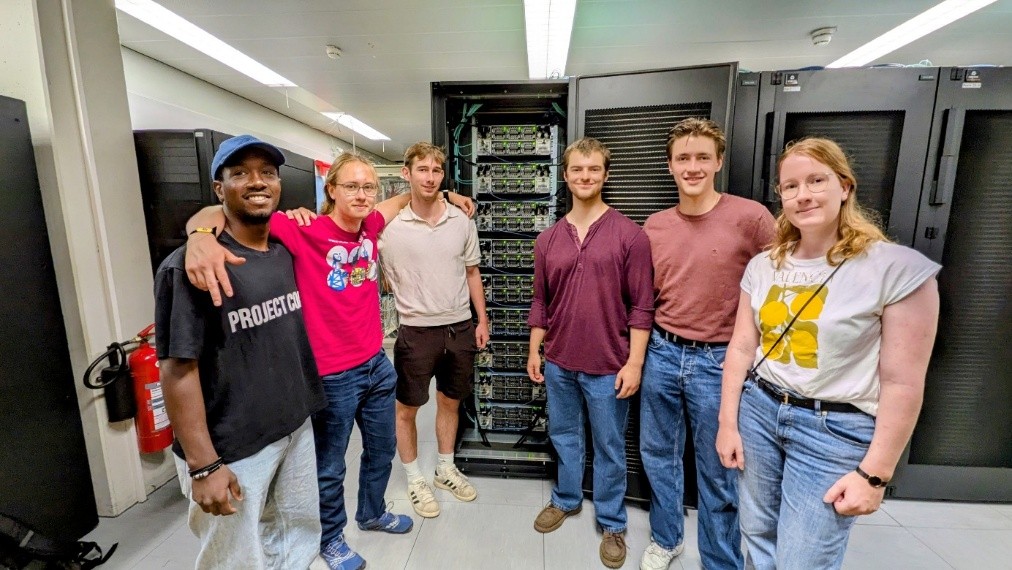
From left to right: Stephane Montcheu Tchuatui, Nikita Bloshchanevich, Leon Weckert, Faris Muzaferija, Oliver Kilo, Anna-Lena Burger, ©NHR@FAU
Anna-Lena Burger
Anna-Lena is currently in her fourth semester of a bachelor's degree program in computer science. As part of the “Jugend forscht” competition, she has already worked with simulations in Blender, and enjoys math, which helps her to understand in detail the benchmarking problems that are part of the competition. She was approached by another teammate to participate in the SCC, which she was enthusiastic about. She sees her future in a mathematics field, such as computational mathematics or working with modeling and simulation.
Faris Muzaferija
Faris is pursuing a bachelor’s degree in computational engineering and currently in his fourth semester. The skills he has acquired in his degree program thus far combine mathematics, computer science, and engineering. “This combination enables me to gain a deep understanding of complex mathematical and physical problems and to solve them using computer-aided calculations, for which I have a strong theoretical and practical foundation,” he said.
When he first heard about high-performance computing (HPC), he knew right away that he wanted to specialize in it. “For me, as a computational engineering student, HPC is the logical next step. Here, I can optimally combine my knowledge of physics and computer science to efficiently solve complex scientific problems. HPC drives modern innovation, and I want to play an active role in shaping this future.”
He would love to use his HPC knowledge to become an engineer working on aerodynamics in Formula 1.
Leon Weckert
Leon is pursuing a bachelor’s degree in computational engineering, so from his perspective supercomputing is naturally a great fit thematically. “The techniques you learn in this academic program are reused in the applications you get to optimize during the competition. The technical foundation helps me understand the algorithms,” he said. His main focus in the program is on simulation using systems of equations, which pairs neatly with some of the SCC tasks. Leon was particularly interested in optimizing simulations. In the future he would like to work with and develop simulations in the field of finite element method (FEM).
Nikita Bloshchanevich
Nikita is in his sixth semester studying computer science. As part of his studies, he has acquired many skills relevant to HPC. The computer science program includes a numerical methods course that provides a solid foundation for understanding the numerical fundamentals of HPC applications, such as “why mixed-precision algorithms work in certain HPC contexts”. Friends who work as administrators at the university answered some of his questions about the cluster setup and gave him helpful tips. “The previous team had handed over their cluster setup to us—which we’re building upon—and gave introductory presentations on the Student Cluster Competition.”
His interest in HPC began when he was accepted into the ASC25 and ISC25 teams. He enjoyed both cluster competitions, and was inspired to take a curriculum working with supercomputing, which now allows him to attend SC26.
His current career goal is to become a software developer in the embedded systems field. Nikita feels that HPC is relevant there as well, and that there is a substantial overlap in skills.
Oliver Kilo
Oliver’s current degree program is a bachelor’s degree in computational engineering, and he is in his fourth semester at FAU. The program combines thermal and fluid dynamics, computer science—including programming in Java and C—as well as mathematics and physics. For him, this coursework has been very helpful for understanding the applications and finding ways to optimize them. To prepare specifically for SCC26, the Erlangen National High-Performance Computing Center (NHR@FAU), in cooperation with the Chair of Computer Architecture at FAU, offers a dedicated 6-months curriculum focused on HPC fundamentals and competition preparation. Oliver found out about the SCC curriculum through a recommendation from a fellow student who had had a positive experience with the course. During the curriculum, he particularly enjoyed the simulations and performance engineering. Oliver sees himself working in an engineering field in the future.
Stephane Montcheu Tchuatui
Stephane is currently studying computational engineering and has gained core skills in his degree program. “During my studies, I have gained knowledge in the fields of mathematics, software engineering, machine learning, and AI,” he said. His interest in HPC began early in his studies, when students learned how to solve large matrix operations using numerical methods or how to parallelize a computationally intensive algorithm. Later, Stephane developed an interest in AI as well.
In his future career, he would like to work as an HPC engineer specializing in AI workloads.
We at GCS wish the team every success and hope they enjoy the competition.