


Artificial Intelligence and Machine Learning
Better Models with Scaling Laws
Principal Investigator:
Prof. Dr. Stefan Kesselheim
Affiliation:
Forschungszentrum Jülich, Germany
Local Project ID:
besl
HPC Platform used:
JUWELS Booster at JSC
Date published:
Introduction
How should an AI model’s training change when it is given more data? Researchers at Forschungszentrum Jülich used JUWELS Booster to investigate how training settings and neural network building blocks affect performance at scale. The BeSL (Better models with Scaling Laws) project established practical relationships between data budgets, learning rates, and batch sizes. It developed a stable way to train networks with learnable activation functions. The results offer guidance for making better use of supercomputing resources when developing AI models.
Training settings must change with the data budget
Training a large language model involves choices that can strongly affect its performance. The learning rate controls how far the model’s parameters move at each update. The batch size determines how much training data contributes to that update. Finding a good combination usually requires many costly trial runs.
BeSL examined these choices across Transformer models ranging from approximately 32 million to 5 billion parameters. The team used maximal update parameterisation, or µP, a framework for transferring training settings between model sizes, and investigated how those settings should change with the total number of training tokens, the pieces of text processed by a language model.
The critical batch size, a characteristic scale governing the relationship between batch size and the best learning rate, grew approximately in proportion to the token budget. The batch size giving the best validation performance also increased. Keeping the batch size fixed therefore became suboptimal as the data budget grew, even when the learning rate was adjusted [1].
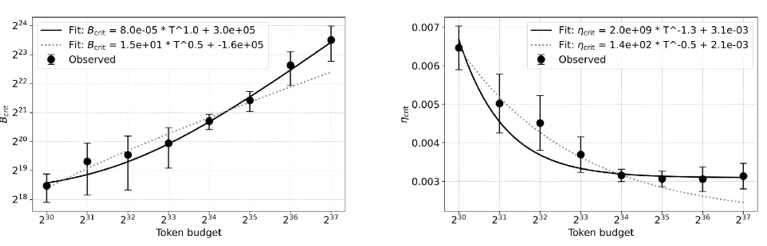
Figure 1.
Training settings change as the data budget grows. The critical batch size rises (left), while the critical learning rate decreases (right). Points show the estimates extracted from the experiments, with uncertainty bars; solid lines show fitted scaling laws. Grey dotted lines show alternative fits with fixed exponents for comparison [1].
A complementary study found a useful indicator called norm transfer. Across models with up to 1.3 billion parameters trained on up to 138 billion tokens, the best learning rate and batch size combinations produced nearly the same operator norm of the output layer, a measure of how strongly that layer can amplify a signal. This pattern held for both Adam and Scion optimizers. Matching the norm alone did not guarantee the best result, but it offered a guide for tuning across scales [2].
Learning the activation functions
The project also revisited activation functions, the nonlinearities that shape signals as they pass through a neural network. Standard models usually use a fixed function such as ReLU or GELU... BeSL explored functions whose shape can instead be learned during training.
The researchers studied three families: Hermite polynomial functions, Fourier functions built from sines and cosines, and Tropical functions formed from maxima of linear expressions. Polynomial and trigonometric activations can be difficult to train because signals and gradients may grow uncontrollably or fade as they pass through many layers.
The team developed a variance-preserving initialisation method that balances the scale of signals and gradients at the start of training. This enabled the functions to be used in deep networks without additional clamping mechanisms. Tests used GPT-2 for language modelling on OpenWebText and ConvNeXt for image classification on ImageNet-1K. The report describes performance comparable to, and in some tested configurations better than, standard activations. The work was published at ICLR 2026 [3].
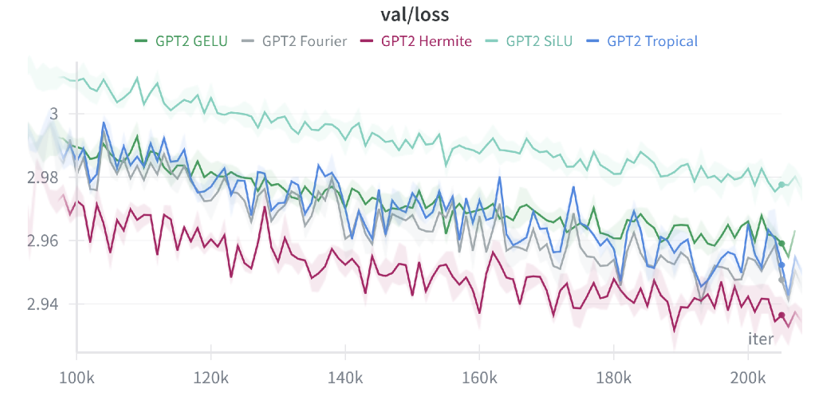
Figure 2.
Learnable activations in language modelling. Validation loss for GPT-2 (124 million parameters) on OpenWebText is plotted against training iterations; lower values indicate better predictions. Hermite activations achieve the lowest loss in this comparison. Lines show the mean over five random seeds, and shaded bands show the minimum-to-maximum range.
Why supercomputing was essential
The scaling studies used JUWELS and JURECA, with additional GPU resources from WestAI. JUWELS was the main computing platform for the scaling studies, while JURECA and WestAI provided a few nodes for smaller experiments and evaluations. Estimated computational requirements ranged from a few nodes up to 256 A100 nodes (1,024 NVIDIA A100 GPUs), depending on model size and training budget. Individual training runs lasted hours to days. The experiments covered models ranging from approximately 32 million to 5 billion parameters and training budgets from 1 billion to 275 billion tokens, including extensive searches over learning rates and batch sizes.
Alongside the scaling studies, the activation-function experiments required full training runs, repeated trials, and targeted comparisons to isolate the effects of individual design choices. On JUWELS Booster, each baseline activation run used 32 A100 GPUs for 24 hours. Fourier and tropical activation runs used 64 GPUs, while Hermite runs used 128 GPUs over the same wall time.
Open tools
The team released TorchOrtho, a PyTorch library for learnable activation functions, and developed Disco to support distributed, norm-aware optimisation [4, 5]. These tools allow other researchers to examine and replicate the methods in their own training workflows.
References and links
[1] O. Filatov, J. Ebert, J. Wang and S. Kesselheim. Time Transfer: On Optimal Learning Rate and Batch Size in the Infinite Data Limit. arXiv:2410.05838, 2024; revised 2025. arxiv.org/abs/2410.05838
[2] O. Filatov, J. Wang, J. Ebert and S. Kesselheim. Optimal Scaling Needs Optimal Norm. arXiv:2510.03871, 2025. arxiv.org/abs/2510.03871
[3] I. Khalfaoui-Hassani and S. Kesselheim. Polynomial, trigonometric, and tropical activations. International Conference on Learning Representations, 2026. arxiv.org/abs/2502.01247
[4] TorchOrtho source code. github.com/K-H-Ismail/torchortho
[5] Disco source code. github.com/SDLAML/disco