


ASTROPHYSICS
THESAN-ZOOM: Simulating Galaxies in the Early Universe
Principal Investigator:
Dr. Ewald Puchwein
Affiliation:
Leibniz-Institut für Astrophysik Potsdam, Germany
Local Project ID:
pn29we
HPC Platform used:
SuperMUC-NG PH1-CPU and SuperMUC-NG PH2-GPU at LRZ
Date published:
Summary
The THESAN-ZOOM project follows the birth and growth of galaxies during the first roughly two billion years of cosmic history, the era when the very first galaxies formed and their light gradually transformed the gas filling the Universe. Using a new generation of computer models that track both matter and radiation, the team followed 14 representative galaxies from their initial formation to their later, more settled states, resolving the individual clouds in which stars are born. The simulations, carried out on the SuperMUC-NG supercomputer at the Leibniz Supercomputing Centre, help astronomers interpret the distant galaxies now being observed in detail by the James Webb Space Telescope.
A new look at the first galaxies
How did the first galaxies form, and how did they change the Universe around them? In the first few hundred million years after the Big Bang, space was filled with a cold fog of hydrogen gas. As the first stars and galaxies formed, their light gradually heated this gas and split the electrons off the atoms, a process astronomers call “reionization”, until the Universe became transparent. Understanding this era, and what determined the masses, sizes, and chemical make-up of the first galaxies, requires computer models that follow stars, gas, dust, and radiation together under the harsh conditions in which those galaxies grew. The need for such models has recently become even more pressing: the James Webb Space Telescope (JWST) is now finding very distant galaxies that look brighter, more massive, or more chemically mature than earlier predictions had suggested.
The challenge
This is the challenge the THESAN-ZOOM project set out to meet. Building on the earlier, larger THESAN simulations, the team designed a set of “zoom-in” simulations: a small region of the cosmos containing a single galaxy is followed in very fine detail, while the wider universe around it is tracked more coarsely. In total, 14 galaxies were re-simulated this way, ranging from small dwarf galaxies to the ancestors of today’s giant galaxies, together with extra runs that test how sensitive the results are to the assumptions built into the model.
Why supercomputing was required
Such a programme is computationally demanding. The simulations resolve the cold, dense clouds in which stars are born, down to scales comparable to the distance between neighbouring stars. They do not simply move gas around: at every step the model also follows how the light of young stars travels through the gas, heating it and pushing it outward. They track the dust and molecules that form, and the way gas cools, together with the energy released by exploding stars. Most distinctively, the gradual, patchy way in which starlight spread through the early Universe is taken into account, so each zoomed-in galaxy experiences a realistic changing environment.
Computing platform
The simulations were performed on SuperMUC-NG at the Leibniz Supercomputing Centre (LRZ) in Garching, one of the three national supercomputers operated under the umbrella of the Gauss Centre for Supercomputing (GCS). They used a simulation code called AREPO-RT, which follows gas and radiation together on a flexible computational grid that adapts to the flow. Each galaxy required millions of processor-hours, and the full set of around 60 simulations was made possible only by the dedicated large-scale allocation provided by GCS.
Illustration
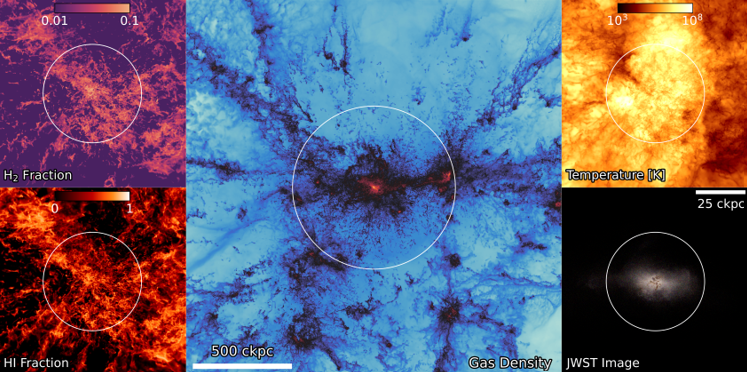
Figure 1. Five views of the same simulated galaxy from the THESAN-ZOOM project. The large central panel shows the gas density in a region about 1.5 million light-years across: dark filaments funnel cold gas towards the central galaxy. The smaller panels zoom in on the galaxy itself. White circles show the dark matter halo size in the large panel and the galaxy's visible extent in the small ones. The fraction of gas in molecular form (H₂, top left) and in neutral atomic form (HI, bottom left) traces the cool, dense material out of which stars form; the temperature map (top right) shows hot bubbles blown outward by exploding stars; and the panel at bottom right shows how the galaxy would appear through the James Webb Space Telescope. (Adapted from Kannan et al. 2025.)
Findings
The first results from THESAN-ZOOM are already reshaping the picture of how early galaxies grew. Rather than forming stars in a steady trickle, the simulated galaxies do so in violent, on-and-off bursts: a short, intense burst of star formation is followed by a lull, as energy from exploding stars and starlight temporarily blows the gas away, before fresh gas falls back in and the cycle repeats. This “burst-then-pause” behaviour naturally explains the surprisingly bright galaxies JWST has been finding, and it leaves chemical fingerprints that match those seen in some of the most distant observed galaxies. Further studies in the series look at how efficiently gas turns into stars inside individual clouds, how starlight escapes from galaxies and how radiation from their surroundings affects small galaxies.
Who benefits from the project
Beyond these specific results, THESAN-ZOOM gives the wider astronomical community a freely available theoretical reference for the JWST era. Because the simulated galaxies can be “observed” in the same way as real ones, astronomers can compare them with the telescope’s images and measurements. This helps turn the flood of new data into a clearer physical picture of how the first galaxies formed and evolved, how they reshaped the gas around them, and how they set the stage for galaxies like our own Milky Way.
References and further information
1. Kannan, R. et al. (2025), "Introducing the THESAN-ZOOM project: radiation-hydrodynamic simulations of high-redshift galaxies with a multi-phase interstellar medium", The Open Journal of Astrophysics, 8, 153. https://arxiv.org/abs/2502.20437
2. McClymont, W. et al. (2025), "Burst, quench, repeat – unveiling the evolution of high-redshift galaxies along the star-forming main sequence", MNRAS, 544, 513. https://arxiv.org/abs/2503.00106
3. Shen, X. et al. (2025), "Star-formation efficiencies in high-redshift galaxies", MNRAS, 545, 2119. https://arxiv.org/abs/2503.01949
4. Project website with full list of publications, movies and images: https://www.thesan-project.com/thesan-zoom/