


ELEMENTARY PARTICLE PHYSICS
Beyond the Standard Model Matrix Elements from lattice QCD
Principal Investigator:
Prof. Tom Luu
Affiliation:
Forschungszentrum Jülich GmbH, IAS-4 Institute for Advanced Simulations - Theorie der starken Wechselwirkung, Jülich, Germany
Local Project ID:
standardmodelmatrix
HPC Platform used:
JEWWELS BOOSTER at JsC
Date published:
Introduction
Describing the behavior of quarks and gluons—fundamental particles of the Standard Model of particle physics occurring at length scales of less than a femtometer – is of prime importance in understanding the formation of hadrons and nuclei, such as the neutron, proton, or pion, and their interactions. A deeper understanding of their interactions in turn allows us to better predict the behavior of nuclear matter in extreme conditions, like those that occur in compact astrophysical environments like neutron stars or during type II supernovae, and allows us to disentangle and identify physics beyond the Standard Model (BSM) in experiments occurring, for example, at CERN
Project
Simulating quarks and gluons is not easy, however, as the equations that describe their behavior are highly non-linear and preclude the use of perturbation theory. Numerical calculations are therefore requisite — space and time are discretized on a 4-dimensional lattice and stochastic simulations, known as lattice-QCD (quantum chromodynamics), are performed. Because of the strong correlations and required large dimensions, supercomputers like the JUWELS-Booster are used to perform such simulations. Such simulations are the only possible ab-initio calculations of QCD at energy scales indicative of hadronic physics.
In the GCS project “standardmodelmatrix”, PIs Thomas Luu and Andrea Shindler tackled the central question of the origin of time-reversal violating effects in BSM physics, which would lead to an induced electric dipole moment (EDM) in the neutron. Though not yet experimentally detected, such a signature is actively being searched for since its presence would be a smoking gun for the presence of BSM physics. Luu and Shindler concentrated on calculating specific hadronic matrix elements from lattice QCD that would signify the presence of these time-reversal violating effects. By using the gradient flow formalism (basically a 4-dimensional differential heat equation), they were able to demonstrate that the a particular time-reversal violation, known as the Strong CP Problem, does indeed lead to an induced neutron EDM from lattice QCD.
The same gradient-flow formalism has also become a powerful tool in a broader class of lattice-QCD calculations of hadronic matrix elements. In particular, Shindler and collaborators have recently applied gradient-flow methods to the calculation of moments of parton distribution functions (PDFs), which describe how the momentum of a hadron is distributed among its quark and gluon constituents. These quantities are central to our understanding of hadron structure and provide important input for the interpretation of high-energy scattering experiments.
Traditionally, lattice-QCD calculations of PDF moments using local operators have been limited by renormalization and operator-mixing problems, especially for moments of order two and higher. The gradient-flow approach offers a new strategy: the relevant operators are defined at positive flow time, where their renormalization properties are better controlled. This makes it possible to take the continuum limit at fixed physical flow time and subsequently connect the lattice results to physical PDF moments through a short-flow-time expansion.
This recent work should be viewed as a methodological continuation of the broader research program developed in “standardmodelmatrix”: the use of high-performance computing, lattice QCD, and gradient-flow techniques to calculate difficult hadronic matrix elements directly from the underlying theory of quarks and gluons. While the original GCS project focused on matrix elements relevant for precision Standard Model physics and searches for BSM physics, the same computational and theoretical tools now open new opportunities in hadron-structure physics.
Relevant publications associated with this research direction include the lattice-QCD determination of the neutron EDM induced by the QCD theta term, the nonperturbative study of power-divergent mixing for the quark chromoelectric dipole moment using the gradient flow, and a recent proceedings overview of electric dipole moments and related gradient-flow applications.
References and project-related publications
[1] J. Dragos, T. Luu, A. Shindler, J. de Vries, and A. Yousif, “Confirming the existence of the strong CP problem in lattice QCD with the gradient flow,” Phys. Rev. C 103, 015202 (2021). https://doi.org/10.1103/PhysRevC.103.015202
[2] J. Kim, T. Luu, M. D. Rizik, A. Shindler, and SymLat Collaboration, “Nonperturbative renormalization of the quark chromoelectric dipole moment with the gradient flow: Power divergences,” Phys. Rev. D 104, 074516 (2021). https://doi.org/10.1103/PhysRevD.104.074516
[3] A. Shindler, “Electric dipole moments: a gateway to new physics,” PoS EuroPLEx2023, 024. https://pos.sissa.it/451/024/
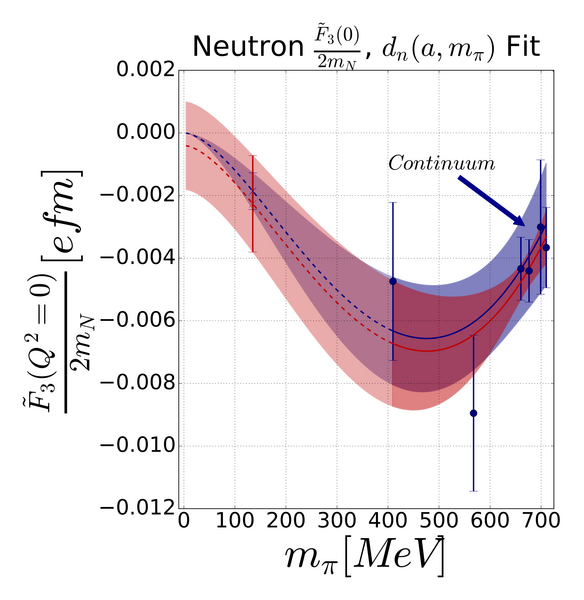
Figure 1. Determination of the neutron electric dipole moment as a function of the pion mass for the simulated ensembles. The bands show fits to the ensemble data, evaluated both in the continuum limit and including a parametrization of discretization errors.
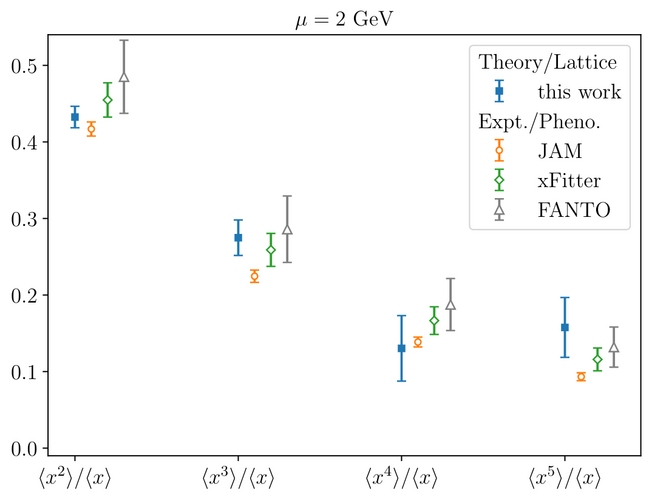
Figure 5. Comparison of continuum-extrapolated lattice-QCD results for the pion PDF moment ratios <xn-1>/<x> at μ = 2 GeV, obtained at a pion mass of approximately 411 MeV, with phenomenological extractions of the valence sector from JAM, xFitter, and FANTO global fits to experimental data.