


ENVIRONMENT AND ENERGY
Chemical Lagrangian Model of the Stratosphere (CLaMS)
Principal Investigator:
Dr. Jens-Uwe Grooß
Affiliation:
Forschungszentrum Jülich GmbH, ICE-4 Institute of Climate and Energy Systems - Stratosphere, Jülich, Germany
Local Project ID:
CLaMS-ESM
HPC Platform used:
JUWELS CPU at JSC
Date published:
Lagrangian simulations of the atmospheric composition help solving longstanding discrepancies
Abstract
The Chemical Lagrangian Model of the Stratosphere (CLaMS) is a Lagrangian Chemistry-Transport model, that was developed in Jülich since 1997. The specialty of this model is the Lagrangian principle. The simulations are not performed on a space-fixed grid but on an adaptive grid that follows the individual air masses. By now, CLaMS has become an internationally recognized model, particularly because the Lagrangian approach makes it is possible to realistically simulate small scale features and large trace gas gradients. Here, we report on two highlights of the extensive outcomes of the project CLaMS-ESM in which the Lagrangian approach has helped to understand long-standing problems and discrepancies in atmospheric modelling, that is the water vapour high bias of climate models in the lower stratosphere with respect to observations and the discrepancy on Hydrogen Chloride (HCl) between models and observations in the early winter polar stratosphere. The simulations have been performed on the supercomputer JUWELS within the GCS project CLaMS-ESM.
Lagrangian simulation of the atmosphere - an uncommon idea
Normally, numerical models that describe the composition of the atmosphere and its development are Eulerian models. That means that the atmosphere is represented in a space-fixed regular grid with a certain resolution. Structures that are smaller than the resolution cannot be represented and the averaging over the grid cells at each time-step causes numerical diffusion such that also larger-scale structures are smeared out by too strong diffusion.
For this reason, the Chemical Lagrangian Model of the Stratosphere (CLaMS) was developed in Jülich since about three decades. Using the Lagrangian principle, the model follows socalled air parcels with information of chemical composition, that are distributed irregularly in space. This principle is completely non-diffusive, thus the mixing processes between the simulated air-masses need to be explicitly formulated. Parameterized mixing is induced only at those locations where we physically expect mixing, for example in regions with large wind shear. With this concept it is possible to simulated gradients of trace gas species near transport barriers much more realistic than in Eulerian models.
A prototype of this model was used for flight planning in the year 2000 during an aircraft measurement campaign with the US research aircraft ER-2 (the former spy aircraft U2), where the model CLaMS was able to predict a filament with enhanced methane (CH4) in the polar region, that really was then observed on the aircraft [1].
Over the last 3 decades, the model CLaMS has been developed from a Lagrangian Chemistry Transport Model (CTM) for the stratosphere only to a global atmospheric model including the troposphere. The possibility of climate model simulation was realized by coupling the model to the Modular Earth Submodel System (MESSy) interface. Over the years, the simulations were performed on the available different supercomputer systems in Jülich.
Water vapour in the upper troposphere and lower stratosphere
One long-standing problem in current climate model is that they typically fail to accurately simulate the water vapour content in the upper troposphere and lower stratosphere. Especially in high latitudes the climate simulations indicate about 3-fold higher water vapor with respect to observations.
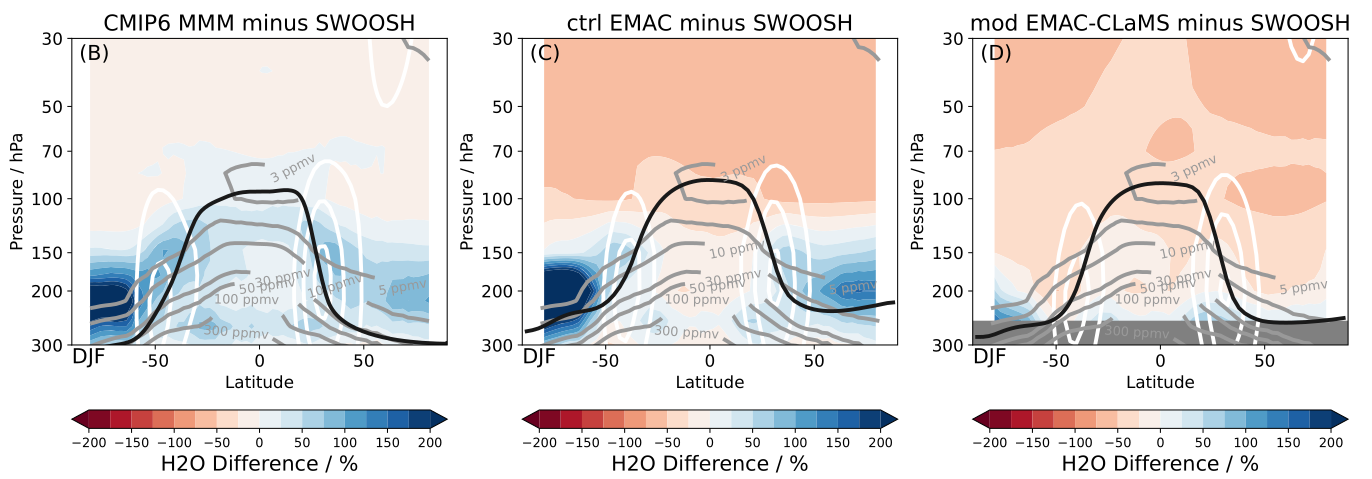
Figure 1: Lowermost stratospheric moist bias in climate model simulations. Relative differences in climatological water vapor distributions compared to SWOOSH merged satellite observations for multi model mean from CMIP6 (left), control EMAC simulation (middle), and Lagrangian modified EMAC simulation (right), for boreal winter (December–February). Figure adapted from [2].
This problem was investigated with the model system EMAC–CLaMS, in which the Lagrangian transport scheme of CLaMS was coupled to the climate model EMAC through the MESSy interface.
The coupled climate model simulations with Lagrangian trace gas transport have been carried out to investigate effects of stratospheric water vapour on atmospheric circulation [2]. In this study, the effects of the Lagrangian versus Eulerian transport scheme in EMAC on stratospheric water vapour have been quantified. In particular, the excessive numerical diffusion in the Eulerian scheme caused overly strong moisture transport from the tropoapshere into the stratosphere, resulting in a significant moist bias in the lower stratosphere compared to satellite observations (see Fig. 1). The Lagrangian CLaMS transport scheme, on the other hand, alleviates this moist bias and results in much better agreement with the satellite observations.
This effect is important since the general moist bias for standard Eulerian transport schemes in state-of-the-art climate models (Fig. 1) causes a cold bias in lower stratospheric temperatures. The changed temperature gradients, in turn, affect atmospheric circulation and cause upward and poleward shifts in the subtropical jet streams as well as poleward shifts in the tropospheric eddy-driven jet. Hence, improvements in the representation of lower stratospheric transport via implementation of a Lagrangian transport scheme has the potential to alleviate biases not only in simulated trace gas distributions but also in atmospheric circulation reaching down to the surface.
Chlorine activation in the polar vortex
The discovery of the ozone hole in 1985 was a big surprise to the scientific community that had not been foreseen, although the risks of anthropogenically emitted CFCs were principally known at that time. After this discovery the principle scientific explanation was found within a few years. It was then established that is caused by gas-phase and heterogeneous processes cause the ozone hole. On the surface of Polar Stratopsheric Clouds (PSCs), rather stable chlorine compunds like HCl and ClONO2 can react to form active chlorine that catalytically destroys ozone within the polar vortex. The chemistry models of the atmosphere generally reproduced observed ozone depletion reasonable well.
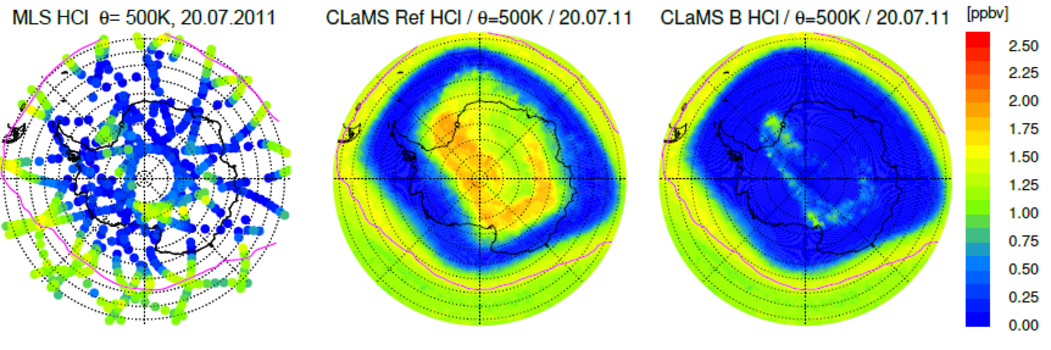
Figure 2: Comparison of the simulation of HCl with observations by MLS. HCl mixing ratios in about 21 km altitude on 20 July 2011 over the Southern polar region, (left) observed by the satellite instrument MLS on the AURA satellite (middle) simulated by CLaMS with the reference chemistry setup and (right) simulated by CLaMS with the proposed additional reactions. The pink line corresponds to the edge of the polar vortex.
However, even three decades later some details were still not completely clear. Observations of HCl at the beginning of the winter in the polar stratosphere showed a fast depletion that was not represented in models. Especially in CLaMS with the non-diffusive Lagrangian scheme this discrepancy became clearly visible. The left panel of figure 2 shows observations of HCl in about 21 km altitude over the polar region and the middle panel the corresponding CLaMS model results for the reference simulation with a state-of-the art chemistry scheme. This significant discrepancy in source gases near the pole, especially in HCl was found not only in our model CLaMS but also in other state-of-the art models [3]. For many years, the cause of this discrepancy was not known and many hypotheses were tested and later discarded.
A literature search pointed to a heterogeneous chemical reaction that was found in the lab and proposed, however this publication from the year 1997 did not receive much attention. In a recent study [4], we examined the impact of this heterogeneous reaction between Cl2O2 and HCl to form HOOCl and its subsequent photolysis on chlorine compounds. A chemical mechanism with these reactions added is able to clearly better reproduce the observed temporal development of the chlorine compounds HCl, ClONO2, ClO, and HOCl in the polar vortex lower stratosphere. The right panel of Fig. 2 shows the HCl simulated with these additional chemical reactions for the same time and location.
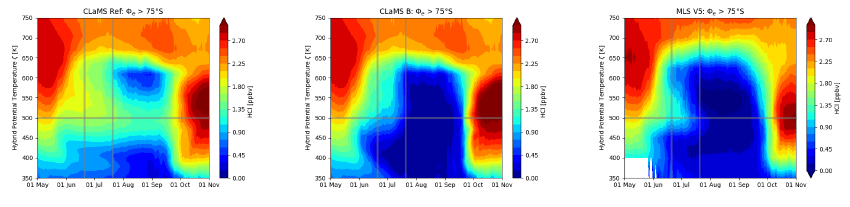
Figure 3: Comparison of the development of HCl observed by MLS and simulated by CLaMS. HCl mixing ratios are averaged in the polar vortex core. The left panel shows CLaMS results from the reference simulation, the middle panel column shows the corresponding simulations with the proposed additional reactions added reactions. The right panel column shows the MLS observations. Adapted from [4].
The corresponding development in time for different altitudes are summarized in Figure 3. It is obvious that with the new proposed chemical mechanism the observations are reproduced significantly better for all altitudes and times. Until the reaction kinetics of the proposed reactions have been confirmed in laboratory measurement, this remains a speculation, that would be however capable of explaining the geographical distribution and its timing in the early stratospheric winter.
References
[1] P. Konopka, H.-M. Steinhorst, J.-U. Grooß, G. Günther, R. Müller, J. W. Elkins, H.-J. Jost, E. Richard, U. Schmidt, G. Toon, and D. S. McKenna, Mixing and Ozone Loss in the 1999-2000 Arctic Vortex: Simulations with the 3-dimensional Chemical Lagrangian Model of the Stratosphere (CLaMS), J. Geophys. Res., 109, 2004.
[2] E. Charlesworth, F. Ploeger, T. Birner, R. Baikhadzhaev, M. Abalos, L. Abraham, H. Akiyoshi, S. Bekki, F. Dennison, P. Jöckel, J. Keeble, D. Kinnison, O. Morgenstern, D. Plummer, E. Rozanov, S. Strode, G. Zeng, and M. Riese, Stratospheric water vapor affecting atmospheric circulation, Nat. Commun., 14, 2023.
[3] J.-U. Grooß, R. Müller, R. Spang, I. Tritscher, T. Wegner, M. P. Chipperfield, W. Feng, D. E. Kinnison, and S. Madronich, On the discrepancy of HCl processing in the core of the wintertime polar vortices, Atmos. Chem. Phys., pp. 8647–8666, 2018.
[4] Jens-Uwe Grooß, Rolf Müller, John N. Crowley, and Michaela I. Hegglin, Chlorine peroxide reaction explains observed wintertime hydrogen chloride in the Antarctic vortex, Comm. Earth & Environment, 6, no. 1, 2025.