


ENVIRONMENT AND ENERGY
How Dancing Atoms Shape Future Energy Materials
Principal Investigator:
Prof. Dr. David Egger
Affiliation:
Technische Universität München, Fakultät für Physik, Theorie funktionaler Energiematerialien, Munich, Germany
Local Project ID:
dyndisml
HPC Platform used:
JUWELS CPU at JSC
Date published:
Abstract
Many promising solar and battery materials are not static crystals: their atoms constantly move around with locally breaking symmetries. In this project, Prof. David Egger’s team used the JUWELS computing facility and machine-learning-accelerated simulations to follow these atomic motions and show how they shape light absorption, ion transport and more. Simulating materials accurately from first principles could be a very computationally demanding task. This is where machine-learning algorithms come into play. The work helps explain experimental measurements and points to faster ways of screening energy materials under realistic conditions.
Report
Many materials that could improve solar cells, LEDs or batteries look orderly in textbook drawings. At room temperature, however, their atoms are never still. They vibrate and form short-lived local structures that differ from the average, static crystal. This dynamic disorder is strong in some energy materials such as halide perovskites. It can change how a material absorbs light, how charges move, and how ions migrate through a battery electrolyte.
The project “Dynamic disorder in strongly anharmonic semiconductors investigated by machinelearning accelerated dynamics” described here was set out to capture this moving atomic world realistically. It was led by Prof. Dr. David A. Egger from the Department of Physics, TUM School of Natural Sciences, Technical University of Munich. The work was carried out by the Theory of Functional Energy Materials group with collaborators.
The challenge addressed here was that common calculations often treat atomic movements as small, regular vibrations around fixed positions. This is useful for simple crystals, but misses the large, irregular motions found in highly anharmonic materials. To overcome this, the team used molecular dynamics simulations, comparable to making an atom-by-atom movie. Each frame requires quantum-mechanical calculations of the forces acting on many atoms, and useful movies must be long and large enough to avoid misleading size effects.
This is why supercomputing was essential. The simulations were run on the JUWELS highperformance computing (HPC) center at Forschungszentrum Jülich. First-principles molecular dynamics and density-functional theory calculations were performed with a combination of publicly available code packages, and home-written code, typically using multiple computer nodes and cores. This made it possible to compare different material sizes, temperatures and settings, and to connect simulated motions to measurable spectra and electronic properties.
One outcome was a clearer picture of how finite-temperature motion controls material behavior. In the nitride semiconductor CuTaN2, simulations showed that tantalum atoms move away from their high-symmetry positions at room temperature. Including these movements changed the predicted band gap, one of the important properties for semiconducting materials applications, from about 0.4 to 0.8 eV, close to the range relevant for solar-energy harvesting. The simulations also helped explain Raman measurements, which detect atomic vibrations.
The team also studied halide perovskites, known for strong light-matter interactions. For CsPbBr3, regular harmonic vibrations (which resemble a pendulum moving around its equilibrium position) could not explain the observed temperature behavior of the band gap. The electronic structure is instead linked to anharmonic fluctuations: larger and less regular atomic motions. In simulations of the two-dimensional perovskite BA2PbI4, the size of the simulated crystal cell affected how phase changes appeared, showing that carefully tuning simulation parameters is crucial to capture the correct physics.
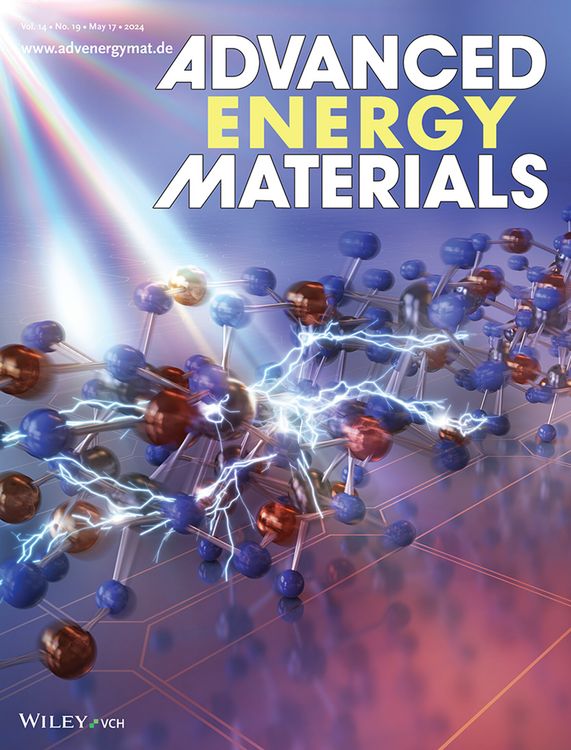
Cover picture of Paper 4: Anharmonic vibrational effects in the nitride semiconductor have a large impact on the fundamental properties of this material, causing an opening of its band gap to a near-optimal value for solar energy harvesting.
Machine learning was also key. Machine-learned force fields were tested on solid-state ion conductors, including AgI, Li10GeP2S12 and Na3SbS4, where ions move through a vibrating host lattice. Compared with first-principles molecular dynamics, which solve the quantum equations of matter explicitly, the machine-learning simulations reproduced ion migration mechanisms and key structural and vibrational properties at much lower cost, making simulations that seem to be impossible with today’s computing resources, a reality. The project also advanced a Δ-machine-learning method that uses machine-learning methods on top of quantum simulations, for predicting Raman (atomic vibrations) spectra from molecular dynamics trajectories.
The insights benefit researchers designing materials for photovoltaics, light-emitting devices and safer solid-state batteries. By showing when atomic disorder helps or hinders a desirable property, the work supports better screening rules before materials are made in the laboratory. It also helps experimental groups identify which atomic motions are responsible for light-absorption, Raman or ion-transport signals. It demonstrates how supercomputing and machine learning can make materials discovery faster and more realistic.