


ENVIRONMENT AND ENERGY
Modeling Oceanic Signals in Europe’s Atmospheric Water Cycle
Principal Investigator:
Dr. Michael Schindelegger
Affiliation:
University of Bonn, Institute of Geodesy and Geoinformation, Bonn, Germany
Local Project ID:
moistly
HPC Platform used:
JUWELS CPU of JSC
Date published:
Introduction
How do subtle differences in ocean temperatures alter the rain falling over the European continent? In the supercomputing project "moistly," researchers from the University of Bonn investigated how regional climate models react when their underlying sea surface temperature field is exchanged for another. Using the JUWELS cluster at the Jülich Supercomputing Centre, the team simulated the atmospheric water cycle across Europe over a total of nine model years. They discovered that even minute variations in sea surface temperature data can shift simulated continental rainfall by more than 6% in places and intensify heavy rainfall events. These findings benefit efforts to project, and adapt to the hydro-meteorological impacts of climate change.
Project
Ocean Temperatures and European Rain
Global warming is fundamentally altering the water cycle, making the accurate projection of regional weather patterns a matter of importance for European infrastructure, agriculture, and natural hazard management. However, regional climate models (RCMs), which simulate atmospheric processes at high resolution over specific continents, heavily depend on the data they receive at their geographical boundaries. One of the most critical inputs is sea surface temperature (SST). Even minor discrepancies in how ocean temperatures are measured or defined can cascade through atmospheric simulations, leading to considerable uncertainties in rainfall predictions over land.
To quantify these uncertainties, a research team at the working group on Geodetic Earth System Science at the University of Bonn, launched the high-performance computing project "Modeling Oceanic Signals in Europe's Atmospheric Water Cycle" (Project ID: moistly). The team focused on the EURO-CORDEX domain, that is, the entire European continent and its adjacent marine regions. At the heart of the considerations was a subtle but consequential physical distinction: the difference between bulk sea surface temperatures (defined as average over a few meters below the surface) and skin temperatures associated with the actual micro-surface layer. Due to the day-night cycle and the action of atmospheric winds, the ocean's skin is typically ~0.2 degrees cooler than the underlying bulk water. Climate simulations have long overlooked this distinction, often driving atmospheric models with foundation or bulk temperatures, or even switching between the two variables. The project therefore set out to discover how this systematic temperature difference alters the moisture transport from the Northeast Atlantic Ocean, the Baltic Sea, and the Mediterranean Sea onto the European continent in a state-of-the-art RCM.
The Computational Challenge
Simulating atmospheric processes—such as the exchange of heat, moisture, and momentum—with the necessary detail over many years is a major computational task. To that end, the research team deployed the Icosahedral Nonhydrostatic modeling framework in climate limited-area mode (ICON-CLM), configured with 60 vertical layers and a spacing between horizontal grid points of about 12 km. See Animation 1 for an illustration of how water vapor in ICON-CLM is transported from the ocean to the continent for the time period January 2003. To isolate the impact of the marine boundary conditions, the team performed extensive parallel sensitivity experiments spanning 456 historical months (in repeated integrations of the period 2002–2011). The project was very data-intensive, involving the processing of roughly 12.2 terabytes of read inputs and generating 9.4 terabytes of written model outputs for every single simulated month. Managing these massive workflows while solving the model’s differential equations required the high-performance computing infrastructure of the JUWELS Cluster Module at the Jülich Supercomputing Centre. For each individual model integration, the team utilized 16 computational nodes (768 physical cores) simultaneously to achieve the necessary parallel efficiency.

Animation1: An animation showing the temporal and spatial evolution of the vertically integrated water vapor transport (IVT) in ICON-CLM for one model month (January 2003). Units are [kg m-1 s-1] and the vertical integration was taken from the surface to altitudes corresponding to 200 hPa. The black arrows indicate simulated winds that are responsible for the moisture transport.
Key Findings
The ICON-CLM simulations performed on JUWELS revealed that fractional changes in SST matter (Figure 1). Using foundation ocean temperatures instead of the slightly cooler skin temperatures increased the simulated annual rainfall over the European continent by 2.4% when averaged over all land points. This difference translates to an additional 12 millimeters of water per year, driven entirely by enhanced evaporation over the warming seas and subsequent moisture transfer to land. In several regions, such as over the Eastern European Plain and the coastlines of Italy or Spain, the increase in annual rainfall reached 6% or more, with larger contributions from summer than winter months. Crucially, the supercomputing data showed that this additional moisture does not manifest as a gentle, uniform drizzle. Instead, it systematically shifts statistics toward more intense precipitation events. Furthermore, the simulations highlighted the important role of internal model variability. During winter, European weather is largely dictated by strong, predictable Atlantic jet streams. In summer, however, when these large-scale atmospheric steering forces are weak, local thermodynamic processes can become very prominent and amplify the model response to small differences in the adopted SST fields.
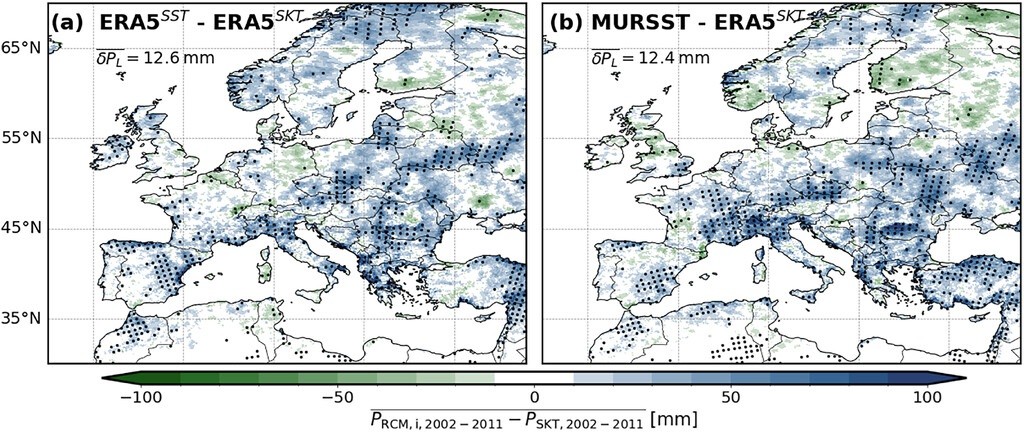
Figure 1: Simulated changes in European annual precipitation (2002–2011 average) when modifying the sea surface temperature (SST) in the ICON-CLM model. Three SST datasets were tested, namely, two foundation temperature products (ERA5SST, MURSST) and one skin temperature product (ERA5SKT). Units are [mm], stippling indicates statistical significance at 90% confidence, and the number in the top left corner is the domain-averaged precipitation difference.
The insights generated within “moistly” benefit meteorologists, hydrologists, and water resource management in several regards. On the one hand, the choice of the underlying SST in RCM simulations is a factor to mind in the quest for better and better climate projections. On the other hand, the work revealed that the atmospheric responses identified from fractional SST changes can be systemically scaled to larger temperature anomalies, such as a uniform increase of +1 degree. This scalability provides valuable context for other studies of climate change signals over Europe and the associated hydrological extremes.
References
Publication: da Silva Lopes, F., Schindelegger, M., Gutknecht, B., and Kusche, J. (2026). Dynamically downscaled European water budget quantities in the presence of sea surface temperature uncertainty. Journal of Hydrometeorology, 27, 129–149, doi.org/10.1175/JHM-D-25-0018.1