


LIFE SCIENCES
Locally Immobilized Synthetic Enzyme Cascades
Principal Investigator:
Prof. Dr. Holger Gohlke
Affiliation:
Institute for Pharmaceutical and Medicinal Chemistry, Heinrich Heine University Düsseldorf and Institute of Bio- and Geosciences (IBG-4: Bioinformatics), Forschungszentrum Jülich GmbH, Germany
Local Project ID:
CasCar
HPC Platform used:
JUWELS BOOSTER at JSC
Date published:
Teaser
Some enzymes work like molecular machines with moving parts, they must physically reshape themselves to carry out their chemistry. The carboxylic acid reductase NoCAR does exactly this: a flexible swinging arm shuttles a reaction intermediate between two catalytic sites as the enzyme cycles through open and closed shapes. Researchers led by Prof. Dr. Holger Gohlke used 150 supercomputer simulations on the JUWELS Booster at Forschungszentrum Jülich to map this choreography in atomic detail for the first time, revealing unexpected shortcuts in the conformational pathway and identifying how cofactor binding orchestrates each step. The same team also uncovered the binding secrets of a second enzyme, SgMT, opening the door to engineering both catalysts for sustainable pharmaceutical synthesis.
Project
Enzymes are nature’s catalysts, proteins that accelerate chemical reactions with extraordinary precision. In biotechnology, scientists combine multiple enzymes into cascades, where the product of one reaction becomes the starting material for the next, enabling the efficient synthesis of valuable compounds such as pharmaceuticals and fine chemicals. Two enzymes of particular interest are NoCAR, a carboxylic acid reductase from the bacterium Nocardia otitidiscaviarum that converts simple carboxylic acids into useful aldehyde building blocks, and SgMT, a methyltransferase from Streptomyces griseoviridis involved in the biosynthesis of a pharmaceutically relevant ring system found in natural products. Understanding how these enzymes work at the molecular level is key to harnessing their full synthetic potential.
NoCAR carries out its two-step reaction in two separate catalytic domains connected by a flexible “swinging arm”, a molecular tether that ferries the reaction intermediate from one domain to the other. For this hand-off to work, NoCAR must physically change its shape, switching between closed, open, and semi-closed conformations during each catalytic cycle. Researchers led by Prof. Dr. Holger Gohlke at Heinrich Heine University Düsseldorf and the Institute of Bio- and Geosciences (IBG-4: Bioinformatics) at Forschungszentrum Jülich characterized these conformational changes for the first time at the atomistic level. Using structural models predicted with ColabFold and RoseTTAFold, Monte-Carlo-based trajectory sampling, and 150 extended all-atom molecular dynamics (MD) simulations of up to 1 μs each, the team mapped the full conformational energy landscape of NoCAR, a 25-fold increase in simulation time compared to prior work. The resulting free energy landscape reveals that direct interconversion between the closed and semi-closed states is energetically more favorable than passing through the fully open state, challenging earlier mechanistic assumptions.
To understand how cofactor binding regulates these transitions, umbrella sampling simulations, a technique that applies a computational bias to explore rare, high-energy events, were used to compute free energy profiles along the transition pathway under different cofactor-bound and -unbound conditions. These calculations revealed that early release of the AMP cofactor lowers the energy barrier for the first conformational transition, while early binding of the NADPH cofactor is required to facilitate the second. This suggests a tightly choreographed sequence of cofactor exchange events underpins each catalytic cycle. Building on these atomistic data, the team also developed a coarse-grained (CG) model of NoCAR using a bottom-up approach, reducing the enzyme’s thousands of atoms to as few as 13 interaction sites while preserving its large-scale motions. Brownian dynamics simulations of up to 600 μs confirmed that these simplified models faithfully capture the conformational flexibility needed for catalysis.
In parallel, unbiased MD simulations of the methyltransferase SgMT, combined with molecular docking and energy calculations, identified a network of active-site tyrosine residues, including Y126 and Y222, that stabilize the substrate in catalytically productive orientations. Validated by site-directed mutagenesis experiments, these findings, published in Chemical Science (2025), also provide a blueprint for expanding SgMT’s substrate scope through rational engineering.
All MD and umbrella sampling simulations were carried out using the AMBER22 suite on the JUWELS Booster Module at the Jülich Supercomputing Centre (JSC) / NIC. The GPU acceleration of the JUWELS Booster was essential for this scale of sampling: the NoCAR conformational study alone encompassed 150 independent microsecond-scale trajectories, an aggregate effort difficult to reach on conventional hardware. The entire computing allocation was fully consumed by the end of the project.
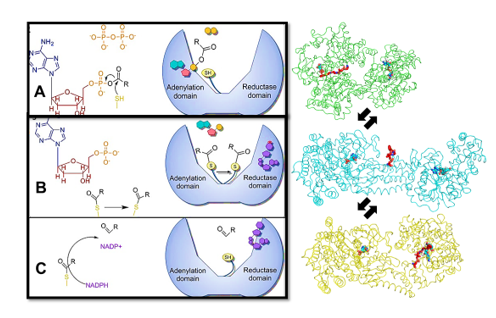
Figure 1. Conformational dynamics of the carboxylic acid reductase NoCAR. NoCAR converts carboxylic acids into aldehyde building blocks via a two-step catalytic cycle carried out in two separate domains (adenylation domain, A; reductase domain, R), connected by a phosphopantetheinyl swinging arm (red). The enzyme cycles through closed, open, and semi-closed conformations. Extensive all-atom molecular dynamics simulations and umbrella sampling on the JUWELS Booster supercomputer reveal the conformational free energy landscape of this transition and show that cofactor binding, early AMP release and early NADPH binding, actively regulates the energy barriers between states, orchestrating the catalytic cycle at the atomic level.