


LIFE SCIENCES
Role of Oligomerization and Substrate Interactions for Cooperativity, Structural Assembly, and Substrate Transport in the Hemolysin A Secretion System
Principal Investigator:
Prof. Dr. Holger Gohlke
Affiliation:
Institute for Pharmaceutical and Medicinal Chemistry, Heinrich Heine University Düsseldorf, Germany and Institute of Bio- and Geosciences (IBG-4: Bioinformatics), Forschungszentrum Jülich GmbH, Germany
Local Project ID:
t1ss
HPC Platform used:
JUWELS BOOSTER at JSC
Date published:
Teaser
Some bacteria export large toxins through a molecular machine that spans their entire cell envelope, powered by three ATP-driven motors working in concert. How these motors coordinate their activity to drive transport had been a long-standing mystery. Researchers led by Prof. Dr. Holger Gohlke used supercomputer simulations on the JUWELS Booster at Forschungszentrum Jülich to simulate million-atom models of the hemolysin A secretion system in all four possible motor configurations. The results reveal that only specific combinations of motor states are stable when fuelled with ATP, providing the first atomistic picture of how this bacterial export machine operates and pointing toward new strategies to interfere with bacterial toxin secretion.
Project
Bacteria have evolved a remarkable variety of molecular machines to export proteins across their cell envelope. One of the most intriguing is the Type 1 Secretion System (T1SS), found in many disease-causing Gram-negative bacteria, including Escherichia coli. The T1SS can export large toxins, sometimes ten times the size of typical exported proteins, directly from the bacterial cell interior into the surrounding environment, bypassing all intermediate compartments. The most intensively studied example is the hemolysin A (HlyA) system, which secretes a potent toxin capable of puncturing red blood cells. Despite its medical significance, the molecular mechanism powering this export machine had remained poorly understood.
The HlyA T1SS is a giant molecular complex spanning the entire bacterial cell envelope. At its core sit three copies of a molecular motor, the ABC transporter HlyB, each powered by ATP hydrolysis. These three motors are interconnected by six copies of the adaptor protein HlyD, forming a hetero-dodecameric assembly that bridges the inner bacterial membrane to an outer membrane channel called TolC. A distinctive feature of HlyB is an N-terminal domain called the C39-like domain (CLD), which is thought to participate in recruiting the HlyA toxin to the transport machinery. Cryo-electron microscopy (cryo-EM) has recently revealed snapshots of this complex in different conformational states, with zero, one, or two of the three HlyB motors adopting an inward-facing, open configuration, but how these states relate to the actual transport cycle, and what role the CLD plays, were open questions.
To investigate these questions, the research group of Prof. Dr. Holger Gohlke at Heinrich Heine University Düsseldorf and the Institute of Bio- and Geosciences (IBG-4: Bioinformatics) at Forschungszentrum Jülich built a complete structural series of HlyB/HlyD complexes, using the experimental cryo-EM structures as templates for computational modeling with ColabFold and Rosetta. This extended the known structural repertoire to include configurations with two and three HlyB protomers simultaneously in the inward-facing state, complementing the experimentally observed zero- and one-inward configurations. Each model was embedded in a realistic lipid bilayer mimicking the inner membrane of Gram-negative bacteria, with ATP bound to all HlyB motor units. These large systems, each comprising over one million atoms, were then subjected to extensive all-atom molecular dynamics (MD) simulations, a computational technique that tracks the physical motion of every atom in the system over time.
The simulations revealed that the stability of the complex is tightly coupled to its conformational state. When all three HlyB motors are in the outward-facing, ATP-competent conformation, the CLD2 domain, one of the two CLDs per HlyB dimer, whose position was not resolved in the cryo-EM structure, displays high conformational mobility. As more motors switch to the inward-facing state, increasing instability propagates through the complex, ultimately destabilizing the HlyD adaptor proteins as well. The fully inward-facing configuration proved the least stable overall, suggesting it is unlikely to be a relevant state in the presence of ATP. Complementary analyses of ATP binding geometry further supported the conclusion that the inward-facing conformation is incompatible with productive ATP binding. Together, these findings provide the first comprehensive picture of the conformational energy landscape of the T1SS during its functional cycle and shed light on the allosteric communication between the three motor units.
All simulations were performed using the AMBER22 suite on the JUWELS Booster Module at the Jülich Supercomputing Centre (JSC) / NIC. The GPU computing power of the JUWELS Booster was indispensable for these unusually large membrane-protein systems: each of the four complex configurations was run as five independent replicas of up to 1 μs each, a cumulative dataset difficult to obtain on conventional hardware. The project consumed approximately 89% of its allocated computing time.
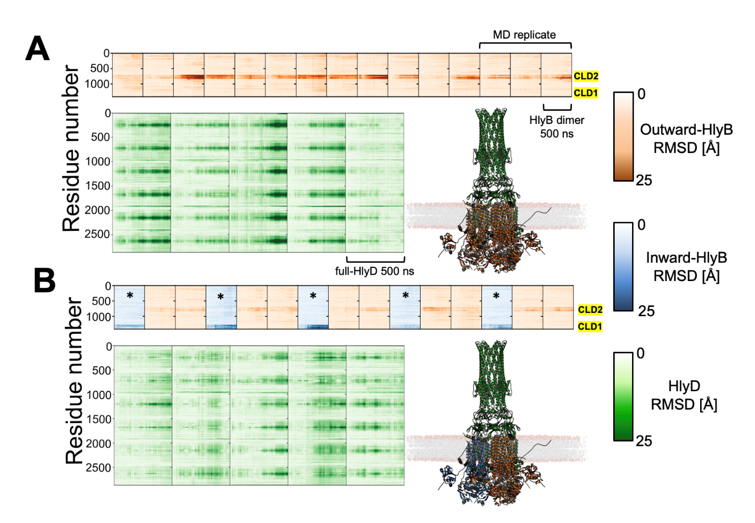
Figure 1. Conformational states of the hemolysin A Type 1 Secretion System. The HlyA secretion system consists of three HlyB ABC-transporter dimers (motors) interconnected by six HlyD adaptor proteins, embedded in the bacterial inner membrane. Molecular dynamics simulations of four configurations — ranging from all three motors in the outward-facing (ATP-competent) state to all three in the inward-facing state — reveal that only configurations with at most one inward-facing motor are stable when ATP is bound. Progressive destabilization of the C39-like domain (CLD) and ultimately of HlyD accompanies the transition toward the fully inward-facing state, providing atomistic insight into the cooperative mechanism of this multi-engine bacterial export machine. Exemplarily shown are best-fit per-residue RMSDs for (A) outward-HlyB + HlyD and (B) inward-outward-outward-HlyB + HlyD.