


LIFE SCIENCES
Role of the Copper Cofactor for Ethylene Receptor Biogenesis and Perception in Plants
Principal Investigator:
Prof. Dr. Holger Gohlke
Affiliation:
Department of Mathematics and Natural Sciences, Institute of Pharmaceutical and Medicinal Chemistry, Heinrich Heine University Düsseldorf, Düsseldorf, Germany and Institute of Bio- and Geosciences (IBG-4: Bioinformatics), Forschungszentrum Jülich GmbH, Jülich, Germany
Local Project ID:
etr1
HPC Platform used:
JUWELS BOOSTER at JSC
Date published:
Teaser
How does a fruit know when to ripen? The answer involves the simple gas ethylene and a receptor called ETR1 that detects it, but only when armed with a copper ion delivered by specialized proteins. Researchers led by Prof. Dr. Holger Gohlke used quantum mechanical simulations and protein docking calculations on the JUWELS Booster supercomputer at Forschungszentrum Jülich to reveal how copper travels through a molecular relay chain to reach ETR1, and how ethylene binding then reconfigures the copper coordination to switch the receptor off. The findings explain at atomic resolution why related compounds block this switch and open new avenues toward controlling fruit ripening and plant stress responses
Project
Ethylene is the simplest gaseous plant hormone, best known for its role in triggering fruit ripening. Plants perceive it through a family of receptors, of which ETR1 (Ethylene Response 1) from the model plant Arabidopsis thaliana is the best-studied member. Crucially, ETR1 requires a copper ion, delivered by specialized carrier proteins called copper chaperones, to bind ethylene with high affinity and specificity. Despite the importance of this signaling system for agriculture and food preservation, the precise molecular details of how ETR1 acquires its copper cofactor and how ethylene binding subsequently switches the receptor off had remained poorly understood.
To address this, the research group of Prof. Dr. Holger Gohlke, spanning Heinrich Heine University Düsseldorf and the Institute of Bio- and Geosciences (IBG-4: Bioinformatics) at Forschungszentrum Jülich, pursued three interconnected lines of investigation over the period 2022–2025. First, the team built and refined a structural model of the transmembrane sensor domain (TMD) of ETR1, the region that binds both copper and ethylene, and performed quantum mechanical (QM) calculations to reveal how ethylene binding alters the coordination of the copper ion at the atomic level. These calculations showed that ethylene and the commercial ripening inhibitor 1-methylcyclopropene (1-MCP) induce distinct changes in copper coordination geometry, providing an atomic-level explanation for why 1-MCP acts as an antagonist rather than a full agonist. Importantly, the findings were validated against experimental data from EPR spectroscopy and X-ray absorption experiments, demonstrating strong agreement between computation and experiment.
Second, the group examined the copper chaperone CCH, which delivers copper to ETR1. Unlike related chaperones, CCH carries an extra flexible tail at its C-terminal end. Through computational modeling and energy decomposition analyses, the team established that this disordered extension stabilizes the CCH dimer by contributing key interaction hotspots, thereby influencing how copper is handled before delivery to the receptor. This was corroborated in collaboration with the Groth laboratory at HHU Düsseldorf through biochemical experiments.
Third, the team reconstructed the complete copper transfer pathway to ETR1, involving the membrane-bound copper pump RAN1. Using protein-protein docking and graph-learning-based contact prediction, the researchers proposed a molecular relay model in which the three metal-binding domains of RAN1 fulfill distinct roles: MBD1 accepts copper from soluble chaperones, MBD2 passes it directly to the ETR1 transmembrane domain, and MBD3 acts as a structural anchor to stabilize the complex. This model was again validated through biochemical experiments performed in close collaboration with experimental partners.
The computationally demanding simulations, including all-atom molecular dynamics, QM/MM umbrella sampling, and extensive docking calculations, were carried out on the JUWELS Booster Module at the Jülich Supercomputing Centre (JSC), using the AMBER22 suite with single-GPU calculations scaled across multiple nodes. The GPU acceleration provided by the JUWELS Booster was essential for achieving the simulation timescales and system sizes required to study these complex membrane proteins with the necessary accuracy. Future QM/MM calculations planned to further validate the ethylene signaling mechanism are intended to leverage the upcoming exascale computer JUPITER at JSC.
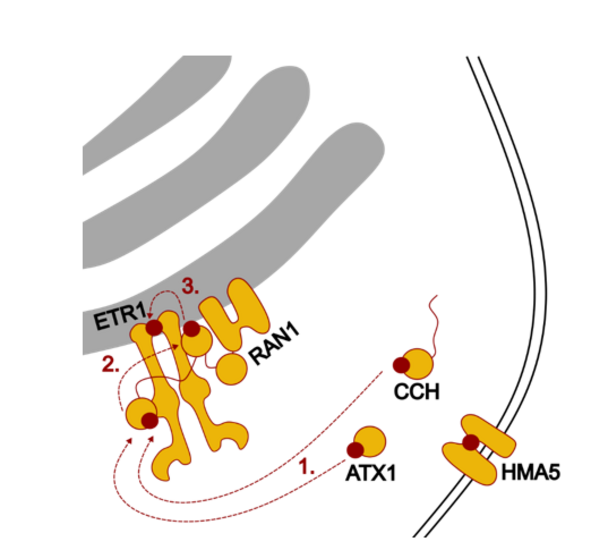
Figure 1. Copper relay mechanism for ethylene receptor ETR1 biogenesis. Schematic of the proposed copper transfer pathway to the plant ethylene receptor ETR1. Soluble copper chaperones ATX1 and CCH deliver Cu(I) to the first metal-binding domain (MBD1) of the membrane-bound P-type ATPase RAN1. MBD2, positioned near the ETR1 transmembrane domain, then transfers Cu(I) directly to the receptor, while MBD3 acts as a structural anchor stabilizing the RAN1–ETR1 complex. The copper cofactor enables high-affinity ethylene binding in the ETR1 transmembrane sensor domain, triggering downstream signaling and fruit ripening.