


MATERIALS SCIENCE AND CHEMISTRY
Liquid-Liquid Phase Separation of RS-Proteins Using Coarse-Grained Models
Principal Investigator:
Prof. Dr. Friederike Schmid and Prof. Dr. Arash Nikoubashman
Affiliation:
Universität Mainz, Institut für Physik, Mainz and IPF Dresden, Germany
Local Project ID:
rsproteins
HPC Platform used:
JUWELS, Cluster Module CPU at JSC
Date published:
Abstract
Proteins do not always adopt a single fixed shape. Some, known as intrinsically disordered proteins (IDPs), continuously change their conformation and can form liquid-like condensates inside cells. This project used high-performance computing to investigate how the sequence and flexibility of such proteins determine their behaviour. Simulations showed that commonly used coarse-grained models differ significantly in their ability to reproduce protein conformations. The work also established a theoretical way of representing heterogeneous protein chains with simpler polymer models and provided initial insights into the phase separation of plant RS-proteins.
Report
Understanding proteins that refuse to stay still
Proteins are often introduced as molecular machines whose three-dimensional folded structures determine their functions. However, many proteins and protein regions do not have one fixed structure. These intrinsically disordered proteins (IDPs) continuously change their shape and can interact with many different molecular partners. Some IDPs can also gather together and form liquid-like droplets inside cells. This process, known as liquid-liquid phase separation (LLPS), is increasingly recognised as an important mechanism for organising biochemical reactions. This project focused particularly on plant RS-proteins, which are involved in regulating RNA processing. Their structure combines relatively well-defined regions with intrinsically disordered segments, making them a challenging class of molecules to study. The central challenge was therefore to understand how the sequence and flexibility of these proteins influence their three-dimensional conformations and their tendency to form condensates.
Directly simulating every atom in hundreds of proteins and in the surrounding aqueous phase is computationally extremely demanding. The project therefore used coarse-grained models, in which groups of atoms are represented by larger particles. This approach makes it possible to investigate much larger systems and substantially longer time scales while retaining the molecular features that are important for the questions being studied. These coarse-grained simulations involved large numbers of protein chains and millions of molecular configurations, thus requiring high-performance computing resources.
The computational resources provided by the JUWELS supercomputer also enabled systematic comparisons between different models. This was important because a model that reproduces the structure of a single protein does not necessarily reproduce the collective behaviour of many proteins during phase separation.
Testing models against experimental protein shapes
The first part of the project examined 64 different intrinsically disordered protein sequences using several coarse-grained models. The simulated radius of gyration, a measure of how extended a protein is, was compared with experimental measurements.
The first coarse-grained model is the UNRES (United-Residue) model, which was originally developed to describe protein structure and folding. A phosphorylated version of UNRES is also available, allowing chemical modifications such as phosphorylation to be incorporated into simulations. This was particularly relevant for RS-proteins, whose behaviour can be affected by phosphorylation. The second coarse-grained model is the popular HPS (Hydrophathy Scale) model, which describes proteins primarily through effective interactions related to the chemical properties of their amino acids. It was developed specifically to study IDPs and their collective behaviour, including phase separation. Variants of the model can include additional interactions to represent structural features such as alpha-helices.
Two versions of the HPS model and a phosphorylated version of the UNRES model reproduced experimental sizes reasonably well. In contrast, the standard UNRES model generally produced proteins that were too compact. Analysis of additional shape measures showed that these proteins tended to adopt overly globular conformations. This comparison provided an important practical result: the standard UNRES model was not sufficiently accurate for the IDP conformations required in this project. The phosphorylated version performed substantially better and was therefore investigated further.
The simulations also led to a more general question. Protein chains are chemically heterogeneous, meaning that different parts of a chain can have different flexibility. Could such a complicated chain nevertheless be represented by a much simpler polymer with one effective measure of flexibility?
To address this question, a theoretical mapping between heterogeneous chains and simpler worm-like chainmodels was developed and tested. Extensive simulations showed that chains with varying local stiffness can, under suitable conditions, be represented surprisingly well by a homogeneous chain with a single effective persistence length. This finding provides a useful bridge between detailed protein models and simpler polymer theories.
From individual proteins to condensates
The second part of the project investigated the phase separation of RS-proteins. Here, an important limitation of the phosphorylated UNRES model was encountered. Although it was suitable for describing individual protein conformations, simulations of many proteins became extremely slow to equilibrate. A detailed examination also revealed that aspects of the model's treatment of electrostatic interactions were not suitable for dense, periodically replicated systems containing many protein chains.
In the following, a HPS model was therefore used, which showed excellent agreement of single-chain conformations with experiments. This approach enabled simulations of 200–400 protein molecules and substantially improved equilibration. Initial parameter sweeps covering 16 RS-protein sequences and variants produced preliminary phase diagrams. The simulations already showed trends consistent with the expected differences in phase-separation behaviour between the proteins. These results provide a basis for selecting the most relevant protein variants and conditions for more extensive simulations and experimental investigation.
New insights and future use
The project demonstrated that no single coarse-grained model is automatically suitable for every question. Models designed to reproduce individual protein structures may not efficiently describe the collective behavior of dense protein condensates. Conversely, models designed for disordered proteins can provide an efficient route to studying phase separation, while simplifying some structural features.
The work therefore provides both scientific results and methodological guidance. The comparison of IDP models clarifies their strengths and limitations, while the effective-persistence-length approach offers a simpler way to connect heterogeneous protein chains with established polymer theory. The phase-separation simulations provide preliminary predictions that can be tested experimentally by collaborating researchers, including the group of Andreas Wachter at Johannes Gutenberg University Mainz. Further simulations can investigate additional RS-protein variants and improve the statistical accuracy of the phase diagrams.
More broadly, understanding how disordered proteins change their conformations and assemble into condensates can contribute to a better understanding of how cells organise biochemical processes. The computational methods tested in this project provide tools for studying these processes at scales that would be difficult to access using atom-by-atom simulations alone.
References
Adam K. Sieradzan et al (2019): Introduction of phosphoryated residues into the UNRES coarse-grained model: Towards modeling of signaling proecesse. J. Phys. Chem. B 123, 5721-5729. ?
DOI: 10.1021/acs.jpcb.9b03799.
Tesei, G. & Lindorff-Larsen, K. (2023): Improved predictions of phase behaviour of intrinsically disordered proteins by tuning the interaction range. Open Research Europe 2, 94.
DOI: 10.12688/openreseurope.14967.2
Witzky, Y., Schmid, F. & Nikoubashman, A. (2025), From heteropolymer stiffness distributions to effective homopolymers. I. Theoretical Modeling and Computational Verification. The Journal of Chemical Physics 163, 164907. DOI: 10.1063/5.0276010.
Witzky, Y., Schmid, F. & Nikoubashman, A. (2025), From heteropolymer stiffness distributions to effective homopolymers. II. Conformational analysis of intrinsically disordered proteins. The Journal of Chemical Physics 163, 164908. DOI: 10.1063/5.0287110.
Images
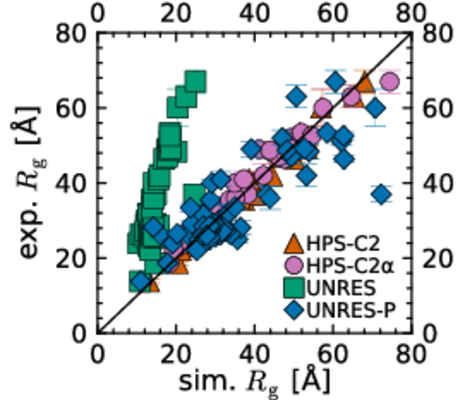
Figure 1: Experimentally measured radius of gyration Rg plotted against simulation results using different models: HPS-C2, HPS-C2α, UNRES and UNRES-P (phosphorylated UNRES)
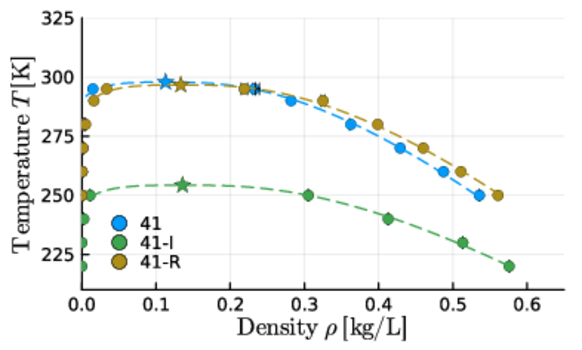
Figure 2: Phase diagram derived with Calvados2 simulations for full-length RS41 (labelled (41), only the IDR section of RS41 (labelled 41-I), and only the RRM section of RS41 (labelled 41-R).