


MATERIALS SCIENCE AND CHEMISTRY
Quantum Chemical Studies of Heavy Metal Systems in Environmental Chemistry
Principal Investigator:
Dr. Sven Krüger, Project team members: Dr. Ion Chiorescu, Dr. Alena Kremleva
Affiliation:
Theoretical Chemistry, School of Natural Sciences, Department of Chemistry, Technische Universität München, Munich, Germany
Local Project ID:
pr94je
HPC Platform used:
SuperMUC-NG PH1-CPU and SuperMUC-NG PH2-GPU at LRZ
Date published:
Abstract
Quantum chemical density functional calculations have been carried out to determine the way actinide(IV) ions bind to calcium silicate hydrate, the essential mineral phase of hardened cement. We showed for U4+ and Th4+ that the preferred binding occurs via replacement of Ca ions in the mineral and not at the surface or between the mineral sheets. This result favorably explains measured interatomic distances. In addition, we find that the binding strength of the actinide(IV) ions can vary between the various actinide elements in dependence of the acidity of the surrounding solution. These results contribute to the understanding of the interaction of radioactive waste with construction materials in a final geological repository and are useful for reliable safety estimates.
Report
The chemical binding of ions from solution to minerals or the incorporation of the ions into them is experimentally easily observable by measuring the relation between the amount of ions in solution and in the solid phase. It is a much harder problem to determine in which way the ions bind to minerals, especially for complex mineral structures. The identification of the way the ions bind at or in a mineral, on the other hand, is a prerequisite for a mechanistically understanding of this process and for its proper thermodynamic description. To solve such questions spectroscopic measurements and quantum mechanical calculations of structures, vibrations and energies are combined. In this project the chemical interaction of actinide ions with minerals of cement has been investigated computationally using the density functional method.
Uranium and some other actinide elements form the major part of radioactive and poisoning waste from nuclear power generation. For the safe and long-term storage of this waste geological underground repositories are planned in several countries. To estimate their safety the chemical interaction of actinides with rocks and with construction and containment materials needs to be understood. The binding to minerals is an essential retardation mechanism, reducing the mobility of the hazardous actinide ions in ground and pore waters. Independent of the rock formation chosen, cement and concrete will be used as construction materials, to build barrier systems and for immobilization of liquid waste. The main mineral of hardened cement is calcium silicate hydrate, generated by the reaction of water with cement. This is a complex mineral, which is composed of stacks of sheets with a central calcium oxide layer decorated on both sides with silicate chains (see Figure). At the surfaces and between the sheets one finds a variable amount of water molecules without crystalline order.
A goal of this computational project was to determine the way actinides bind to calcium silicate hydrate: on the surface, in the interlayer between the crystal sheets or incorporated into the crystal sheets (see Figure). To clarify this question various binding sites have been compared in energy and their structures with X-ray measurements of interatomic distances. Straight structure optimization does not work for this problem as there are very many locally stable minima because of many possible sites and the variable structure of water between the layers and at the surface. Also the number of waters or OH groups binding to the actinide ions varies depending on the site. Thus, dynamic structure equilibration at room temperature and geometry optimization is applied alternating and repeatedly to sort out the more stable binding modes and sites. This procedure is computationally demanding and has to be applied for a large number of potential sites and binding modes. To carry out this project in an acceptable time SuperMUC-NG at the Leibniz Computer Centre has been used with the parallelized software VASP [1].
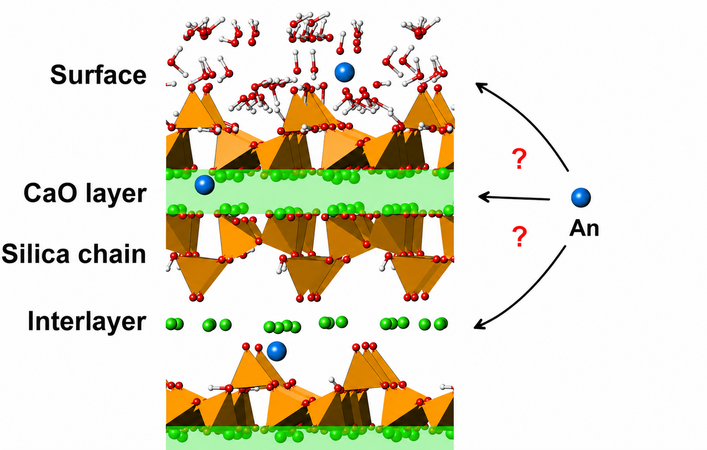
Figure: Idealized structure of calcium silicate hydrate according to the tobermorite model. Blue balls mark various sorption modes of An(IV) ions. Ca is shown as green balls, Si sits in the center of yellow tetrahedra. Water molecules in the interlayer omitted for clarity.
For the example of uranium ions in the reduced oxidation state IV, U4+, we showed that the most stable binding is achieved by replacing a Ca ion in the calcium silicate hydrate crystal sheet [2]. Binding at various sites between the crystal sheets or at a surface was calculated to be weaker. Calculated distances U-O, U-Si, and U-Ca as well as the number of these contacts favorably agree with X-ray measurements for Np4+ and Pu4+, suggesting that all actinides in the oxidation state IV prefer incorporation as a binding mode to calcium silicate hydrate [2]. These results not only allow a definite interpretation of the experimental results but also support the tobermorite like structure model for calcium silicate hydrate.
To explore the unknown effect of the size of the actinide ions to the binding in calcium silicate hydrate we compared uranium to thorium, which forms the larger ion Th4+. As expected, for nearly all binding sites the same complexes were found for uranium and thorium. Also for thorium the incorporation into the crystal lattice is the favorable binding mode. As a new result we showed that thorium binds with comparable strength as uranium only for the basic conditions of fresh cement. With increasing degradation of cement and decreasing basicity thorium binds weaker and thus will be more
mobile compared to uranium.
Overall our results confirm and explain the experimental observation that An4+ ions bind strongly to cement and other minerals, leading to a low mobility in the underground. Our comparison of U4+ with Th4+ gives for the first time a hint on the variation of the binding strength to cement along the actinide series and with the pH. With the decreasing radius of the An4+ ions along the actinide series a stronger binding is expected and differences between the elements should be more pronounced at less basic conditions of lower pH. These trends are useful to establish reliable thermodynamic parameters, which are needed in a sound safety estimate.
References
[1] www.vasp.at
[2] I. Chiorescu, A. Kremleva, S. Krüger, Minerals 12 (2022) 1541.
This work was supported by the German Federal Ministry for Economy and Energy (grant no. 02E11415E) and the German Federal Ministry for the Environment, Climate Action, Nature Conservation and Nuclear Safety (grant no. 02E11860E).