


MATERIALS SCIENCE AND CHEMISTRY
Self-Assembly of Thin Functional Layers via Inhomogeneous Stimuli: Particle-Based Simulations and Continuum Theory
Principal Investigator:
Prof. Dr. Marcus Müller
Affiliation:
Georg-August-Universität Göttingen, Institute for Theoretical Physics, Göttingen, Germany
Local Project ID:
MExMeMo
HPC Platform used:
JUWELS and JUWELS BOOSTER at JSC; JEDI as a preparatory system for JUPITER
Date published:
Abstract
Integral-asymmetric, isoporous block-copolymer membranes [1], which combine a thin selective skin of regular, nanometre-sized pores with a macroporous support, are highly attractive for separation applications. Their fabrication by self-assembly and nonsolvent-induced phase separation (SNIPS) is challenging because it couples several processes: evaporation-induced self-assembly (EISA), solvent–nonsolvent exchange, nonsolvent-induced phase separation (NIPS), and glassy arrest. Using JUWELS, JUWELS Booster, and JEDI, we developed a digital twin of the entire fabrication process, which combines particle-based simulations with a continuum description to reduce the computational cost. With it, we elucidated how material parameters and processing conditions control the orientation of the cylindrical channels and the pore size. The resulting simulation framework provides insight into the physics of membrane formation and thereby helps advance separation technologies.
Report
Many separations that are essential to daily life and industry – from purifying water to isolating proteins – can be performed by membranes with less energy than by heat-driven methods such as distillation. A particularly promising class are integral-asymmetric, isoporous block-copolymer membranes (IAIMs). Their very thin top layer contains uniform, nanometre-sized pores that act as a precise sieve, while a much more open layer underneath provides mechanical support without strongly impeding the flow. Both layers form from the same material in a single, streamlined manufacturing process known as self-assembly and nonsolvent-induced phase separation (SNIPS).
Behind this apparent simplicity lies a difficult scientific problem. SNIPS consists of two consecutive steps (Figure 1). In the first, evaporation-induced self-assembly (EISA), solvent evaporates from a thin film of block-copolymer solution. The copolymer becomes enriched near the surface and self-assembles into cylinders oriented perpendicular to the film. In the second, nonsolvent-induced phase separation (NIPS), the film is immersed in a nonsolvent bath. The exchange of solvent and nonsolvent turns the cylindrical domains into open pores and triggers phase separation in the underlying solution, which forms the macroporous support. The final, nonequilibrium membrane structure depends sensitively on the composition of the casting solution and on the processing conditions. Small changes in the chemistry of the polymer, solvent, or nonsolvent, in the block composition or mobility of the polymer, or in temperature or concentration can markedly alter the resulting membrane.
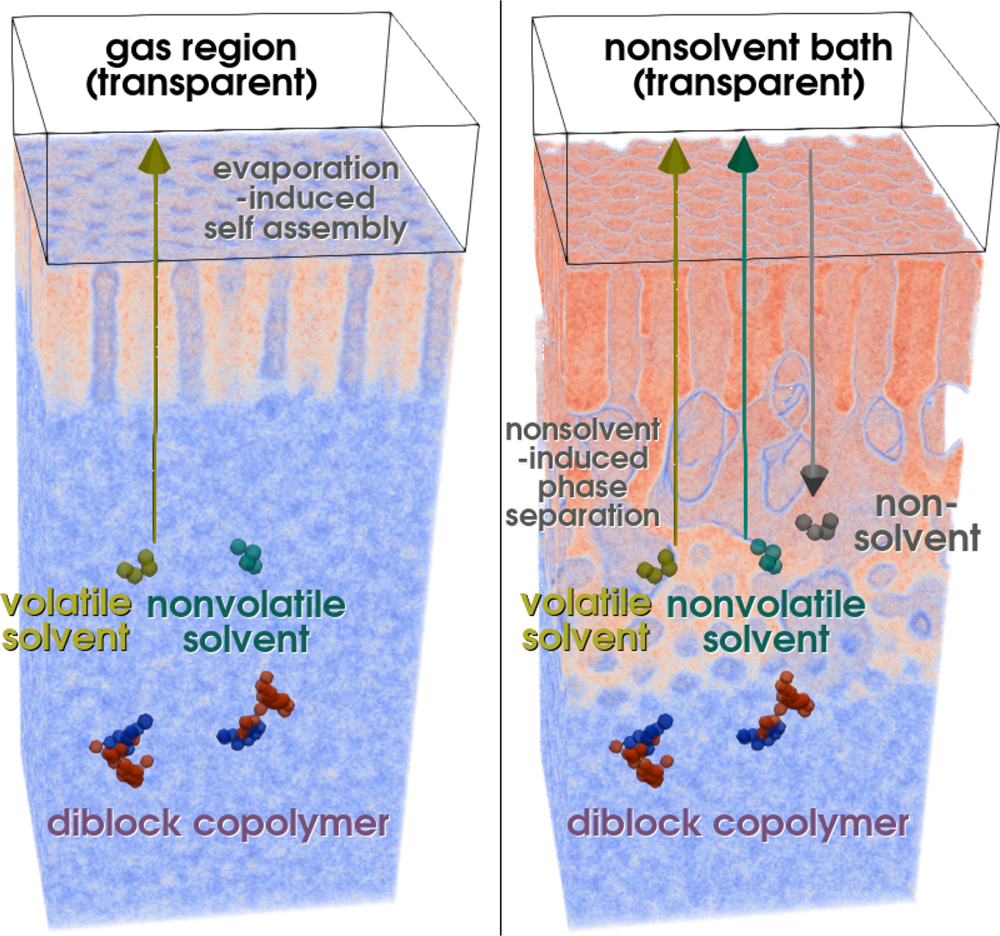
Figure 1: Schematic showing the process of EISA (left) and NIPS (right). From [2]
Because these processing–structure–property relationships are so intricate, membrane development still relies largely on experimental trial and error, and predicting the outcome of a given formulation remains exceptionally difficult. Computer simulations offer a complementary route: they can vary each parameter independently and provide access to processes that are difficult to observe in experiments.
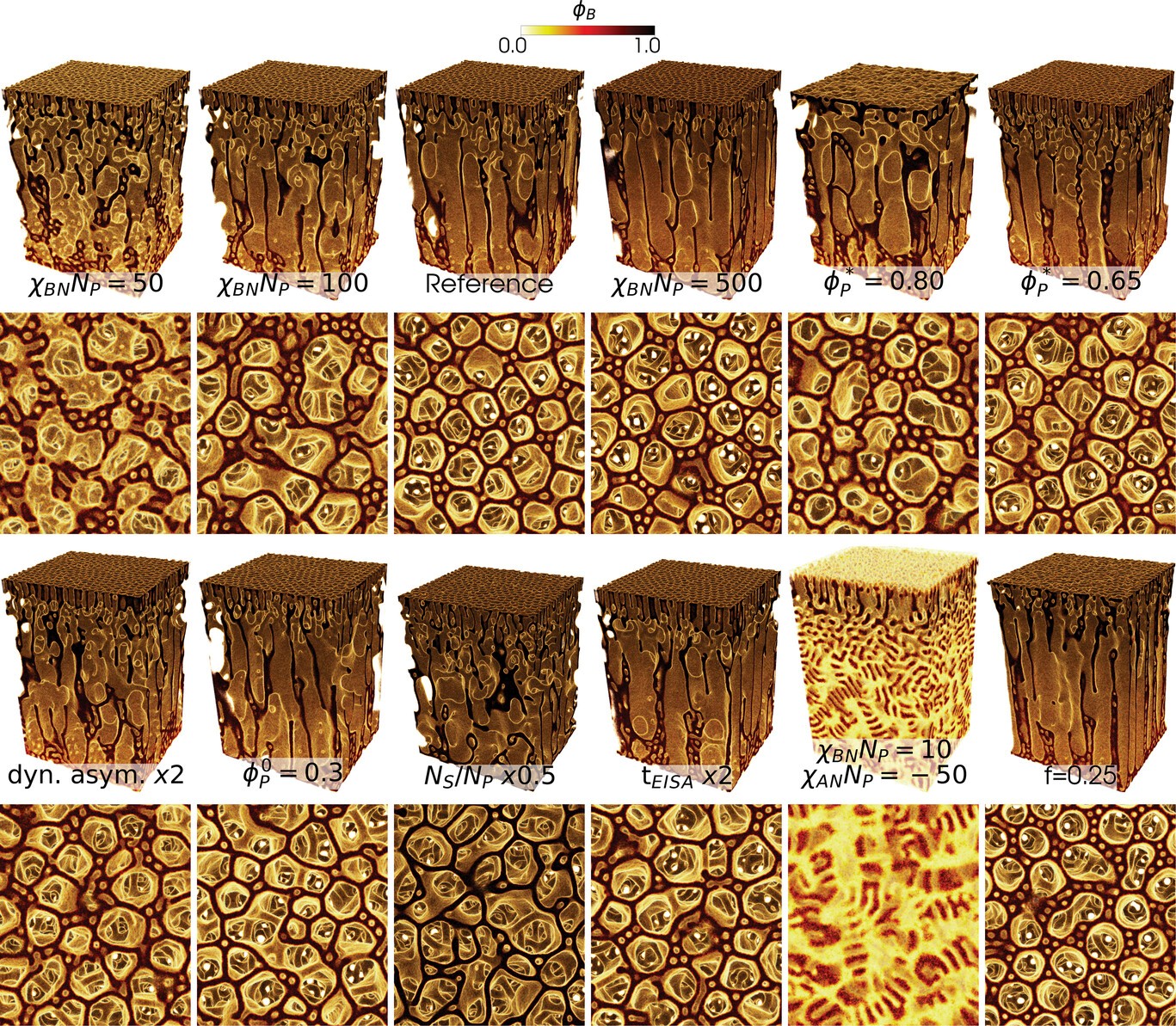
Figure 2: Final membrane morphologies obtained from SNIPS simulations with different parameters, showing the matrix-forming block (B) of the copolymer. Below each 3D snapshot, the same membrane is shown as viewed from the bottom. In the reference system, the cylinder-forming block (A) makes up a fraction f = 0.3125 of the copolymer. The nonsolvent (N) interacts with the matrix-forming block B and the cylinder-forming block A via χBNNP = 150 and χANNP = 10, respectively, where NP is the number of segments per copolymer chain. Glassy arrest sets in at a polymer volume fraction of ϕ∗P = 0.72, and theinitial polymer volume fraction in the casting solution is ϕ0P= 0.33. Adapted from Ref. [3].
Such simulations, however, face a severe multiscale challenge. They must resolve individual polymer chains on the nanometre scale, while the porous substructure is micrometers thick and forms over seconds to minutes. The GPU resources of JUWELS, JUWELS Booster, and JEDI were therefore essential for these large-scale simulations. The project addressed this challenge along three complementary lines of work:
• Establishing a digital twin of SNIPS. The foundation was a coarse-grained particle model that retains the essential identity and interactions of the polymer blocks, solvent, nonsolvent, and gas. Implemented in the GPU-accelerated program SOMA [4], which uses the single-chain-in-mean-field (SCMF) algorithm, the model allowed us to simulate the complete manufacturing protocol in large systems: during EISA, volatile solvent is converted into gas; replacing the gas with nonsolvent initiates NIPS; and as the polymer concentration increases, molecular mobility decreases and consequently the structure vitrifies and arrests [2]. With this digital twin, we identified a process window in which both the selective cylindrical layer and the macroporous support form, and revealed how both structures evolve.
• Exploring and controlling the morphology. We then used the digital twin to study how molecular, thermodynamic, kinetic, and processing parameters shape the final membrane. Fast evaporation and a surface preference for the matrix-forming block suppress cylinders lying parallel to the surface and favour a perpendicular orientation, which promotes uniform pores [5]. In the substructure, weaker polymer-nonsolvent repulsion, earlier glassy arrest, or a larger mobility contrast produce a fine, sponge-like network, whereas the opposite choices generate larger, elongated pores (Figure 2). Experiments with different polymers, nonsolvents, and bath temperatures corroborated these trends [3]. Moreover, blending in a longer copolymer allows the pore size to be tuned continuously, offering a cost-effective way to adjust the balance between selectivity and permeability [6].
• Accelerating the digital twin by coupling two models. Systematically exploring the large SNIPS parameter space requires many large-scale simulations and hence further acceleration. Molecular detail is essential where structures form but wasteful in regions that are homogeneous or already arrested. We therefore coupled the particle model to a faster continuum model [7] that covers the entire film [8]. A machine-learning coordinator predicts where particle-based simulations are needed. As this region moves through the film, the two models exchange solvent fluxes consistently. The coupled framework reproduces the morphologies of full particle simulations with negligible loss of accuracy and is more than an order of magnitude faster [8].
In summary, the project developed a digital twin of the SNIPS process for IAIMs, used it to understand and control the membrane morphology, and, through adaptive model coupling, reduced its computational cost by more than an order of magnitude, bringing realistic length and time scales within reach. Membranes for water treatment, biotechnology, and other separation applications must strike a careful balance between selectivity, permeability, and mechanical stability. By predicting how the choice of materials and processing conditions determines the membrane morphology, which in turn governs this balance, the simulation framework can narrow down the range of candidates that need to be tested experimentally. Future extensions could incorporate hydrodynamic flow and mechanical stresses, and the same computational strategy could be transferred to other soft materials whose structure is directed by nonequilibrium processing, such as e.g. hollow droplets and capsules [9].
References
[1] Marcus Müller and Volker Abetz. Nonequilibrium processes in polymer membrane formation: Theory and experiment. Chemical Reviews, 121(22):14189–14231, 2021. doi: 10.1021/acs.chemrev.1c00029.
[2] Niklas Blagojevic and Marcus Müller. Simulation of membrane fabrication via solvent evaporation and nonsolvent-induced phase separation. ACS Applied Materials & Interfaces, 15(50):57913–57927, 2023. doi: 10.1021/acsami.3c03126.
[3] Niklas Blagojevic, Shibananda Das, Jiayu Xie, Oliver Dreyer, Maryam Radjabian, Martin Held, Volker Abetz, and Marcus Müller. Toward predicting the formation of integral-asymmetric, isoporous diblock copolymer membranes. Advanced Materials, 36(40):2404560, 2024. doi: 10.1002/adma.202404560.
[4] Ludwig Schneider and Marcus Müller. Multi-architecture monte-carlo (MC) simulation of soft coarsegrained polymeric materials: SOft coarse grained monte-carlo acceleration (SOMA). Computer Physics Communications, 235:463–476, 2019. doi: 10.1016/j.cpc.2018.08.011.
[5] Oliver Dreyer, Gregor Ibbeken, Ludwig Schneider, Niklas Blagojevic, Maryam Radjabian, Volker Abetz, and Marcus Müller. Simulation of solvent evaporation from a diblock copolymer film: Orientation of the cylindrical mesophase. Macromolecules, 55(17):7564–7582, 2022. doi: 10.1021/ acs.macromol.2c00612.
[6] Jiayu Xie and Marcus Müller. Process-directed self-assembly of copolymer blends: II. continuous tuning of structure size. Macromolecules, 58(21):11539–11557, 2025. doi: 10.1021/acs.macromol. 5c02630.
[7] Gregor Häfner and Marcus Müller. GPU-accelerated continuum dynamics of block copolymer blends and solutions. The Journal of Chemical Physics, 164(2):024906, 2026. doi: 10.1063/5.0305862.
[8] Gregor Häfner, Matthias Busch, Adel Dabah, Jiayu Xie, Niklas Blagojevic, Shibananda Das, Sonja Happ, Simon Pickartz, Larissa Großmann, Maryam Radjabian, Volker Abetz, Christian J. Cyron, Andreas Herten, Roland C. Aydin, and Marcus Müller. Concurrently coupling particle and continuum simulations to study block copolymer membrane fabrication. The Journal of Chemical Physics, 164 (21):214113, 2026. doi: 10.1063/5.0334617.
[9] Niklas Blagojevic, Ziqi Liu, Chao Lang, and Marcus Müller. Hollow Polymer Droplets and Capsules Formed by Nonsolvent-Induced Phase Separation. Adv. Phys. Res., 4(12):e00037, 2025. doi: 10.1002/apxr.202500037.