


NEWS
Cornerstone Laid for New Building at HLRS
20/Newsflash –
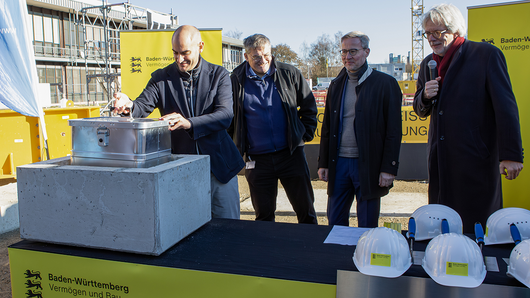
Baden-Württemberg Finance Minister Danyal Bayaz placed a time capsule inside the cornerstone to HLRS, which was then lowered by crane into the construction site. Also speaking at the event were (l-r): Prof. Michael Resch (Director, HLRS), Prof. Peter Middendorf (Rector, University of Stuttgart), and Andreas Hölting (Director, Baden-Württemberg Agency for Property and Construction).
In a ceremony organized by the University Construction Office of Stuttgart and Hohenheim on behalf of the State of Baden-Württemberg Ministry of Finance, friends and supporters of the High-Performance Computing Center of the University of Stuttgart (HLRS) – one of Germany’s three national supercomputing centres within the Gauss Centre for Supercomputing (GCS) – today celebrated the laying of the cornerstone for a new building called HLRS III. Beginning in 2027, HLRS III will house two new large-scale computers: HLRS's next flagship supercomputer, called Herder, and an AI-optimized supercomputer to be installed in conjunction with the AI Factory HammerHAI. Built to accommodate the demanding technical requirements of future high-performance computing (HPC) systems, HLRS III is also designed to use energy as efficiently as possible. With this new facility, Stuttgart will continue playing a leading role in European high-performance computing.
HLRS III will expand on existing HLRS facilities to provide an additional 7,000 m2 of new space. A hybrid construction using reinforced recycled concrete, steel, and wood, HLRS III will contain a state-of-the-art computer room with a redundant power supply, a highly energy-efficient cooling infrastructure, and a building structure capable of supporting the higher weight of future supercomputers.
"The construction of HLRS III marks the beginning of a new stage in HLRS's history, and affirms our HPC center's important role in powering research and innovation in Germany and across Europe," said Prof. Dr. Michael Resch, Director of HLRS. "The new building is a critical piece of infrastructure that is necessary for us to be able to provide our scientific and industrial user communities with access to the next level of supercomputing power. At the same time, it will allow us to operate our systems sustainably."
Energy efficiency and waste heat reuse
Supporting the increased computational capabilities of Herder and other future HPC systems will require more energy than has been available to HLRS in the past. For this reason, maximizing energy efficiency is an essential element of the HLRS III building concept. All of the electricity consumed by supercomputers is transformed into heat, which must be removed from the machine to prevent it from overheating. To take advantage of this valuable resource, a new waste heat processing facility also being constructed next to HLRS III will capture all waste heat generated by the center's supercomputers and distribute it to the district heating network of the University of Stuttgart's Vaihingen campus. Highly efficient, large-scale industrial heat pumps using a climate-neutral refrigerant will be used for this purpose. This approach will cover up to one-third of the campus's heating needs during winter months and all of its process heat requirements in the summer.
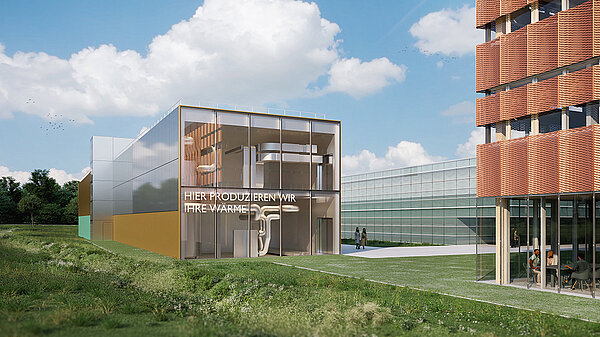
A waste heat processing facility located next to HLRS III will capture and distribute waste heat produced by HLRS supercomputers to the University of Stuttgart's district heating network. Image: Benthem Crouwel Architects, in collaboration with Birk Heilmeyer und Frenzel Architekten
Vital infrastructure for discovery and innovation
The computing infrastructure contained in HLRS III will support advanced computational research for scientists at the University of Stuttgart, in Germany, and across Europe. This includes research in numerous fields, including transportation, climate, health, energy, physics, chemistry, and other disciplines focused on solving global challenges.
HLRS also has a long history of offering the private sector access to high-performance computing capabilities. The systems housed in HLRS III will continue to support large companies, SMEs, and startups in using supercomputing to accelerate research and technology development, and will provide powerful platforms for seizing new opportunities using artificial intelligence and deep learning.
For more and detailed information please visit: https://www.hlrs.de/news/detail/cornerstone-laid-for-new-building-at-hlrs