


NEWS
Everllence Uses HLRS Supercomputers to Accelerate Industrial-Scale Decarbonization
Newsflash 07/2026 –
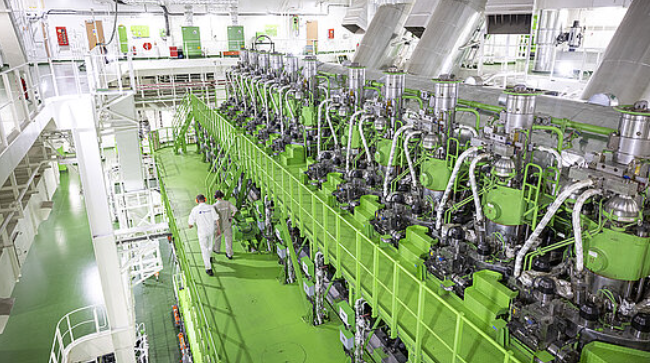
The Everllence B&W ME-GI dual-fuel two-stroke engine can run on marine fuel, liquified natural gas, biomethane, and synthetic natural gas. Photo courtesy of Everllence, © Sebastian Vollmert
Operation of large-scale machinery — for example engines in power plants or cargo ships, or cement manufacturing — is a major global source of the CO2 emissions that are driving climate change. As the world attempts to transition to a more sustainable future, reducing the reliance of such infrastructure on fossil fuels could lead to dramatic reductions in the world’s carbon footprint. For manufacturers of industrial infrastructure this presents a major opportunity, as their expertise and resources place them in an optimal position to design the new, less carbon-intensive technologies that will make this transition possible.
One prominent player in this effort is Everllence, an international mechanical engineering firm based in Germany that is focused on developing technologies for large-scale decarbonization, including engines powered by alternative fuels, more efficient turbomachines, industrial scale heat pumps, and carbon capture and storage facilities.
Simulation with high-performance computing (HPC) is an essential tool for Everllence engineers working to achieve this goal. For the past four years this has meant integrating supercomputing resources at the High-Performance Computing Center Stuttgart (HLRS) – one of Germany’s three national supercomputing centres within the Gauss Centre for Supercomputing (GCS) – into the company’s product development pipeline. Working through HWW and T-Systems, which partner with HLRS to coordinate industrial access to its computing infrastructure, Everllence engineers around the world are using these high-performance computing resources to develop innovative technologies and customized solutions more efficiently.
Everllence is a leading provider of propulsion, decarbonization and efficiency solutions for shipping, the energy economy, and industry. Its machines are also typically both very large and very complex, making research and development impossible without simulation. As a global leader in a very competitive marketplace, access to supercomputing capabilities is also extremely important for accelerating speed to market and achieving the extreme precision required to satisfy demanding specifications.
Before the company began computing with HLRS, simulation engineers at Everllence would face bottlenecks resulting from limited computing capabilities, leading to competition for scarce resources within the company. Large simulations also often exceeded the practical capacity of the company’s in-house systems. Such factors meant needing to wait to run a critical simulation or to purchase computing time elsewhere. Overcoming these limitations is very important, as the ability to simulate quickly and efficiently directly affects Everllence’s ability to complete project proposals and push product development forward quickly.
Meanwhile, exploding demand for high-performance hardware like GPUs and data storage devices presents a supply chain problem for companies like Everllence. Because hardware manufacturers are already struggling to keep up with demand from large-scale data centers and HPC facilities, companies whose primary business is not information technology can find it difficult to purchase hardware of their own.
Gaining access to HPC resources at HLRS solved both of these problems, as simulation engineers now have the ability to access powerful, state-of-the-art computing resources for large simulations on an as-needed basis. Through their partnership with HLRS, companies like Everllance get exactly the services they need—when they need them.
While the technologies that Everllence produces have enormous potential to support decarbonization, the company’s global prominence and its direct engagement with megatrends mean that the future is anything but certain. Factors such as changing national commitments to carbon neutrality targets, political decisions that affect demand for heat pumps, new regulations in the shipbuilding industry, or conflicts in the Middle East that disrupt the fuel industry have significant effects on demand for Everllence’s green technology products and services. Such insecurities also highlight why on-demand access to HLRS’s systems is so important for Everllence, as it gives the company flexibility it needs to adapt quickly to changing market dynamics.
For more detailed information please visit: https://www.hlrs.de/news/detail/everllence-uses-hlrs-supercomputers-to-accelerate-industrial-scale-decarbonization
///////////////////////////
Funding for HLRS's supercomputers was provided by the German Federal Ministry of Research, Technology and Space through the Gauss Centre for Supercomputing and the Baden-Württemberg Ministry for Science, Research, and the Arts.