


NEWS
HLRS Announces Details of Herder Supercomputer
19/Newsflash –
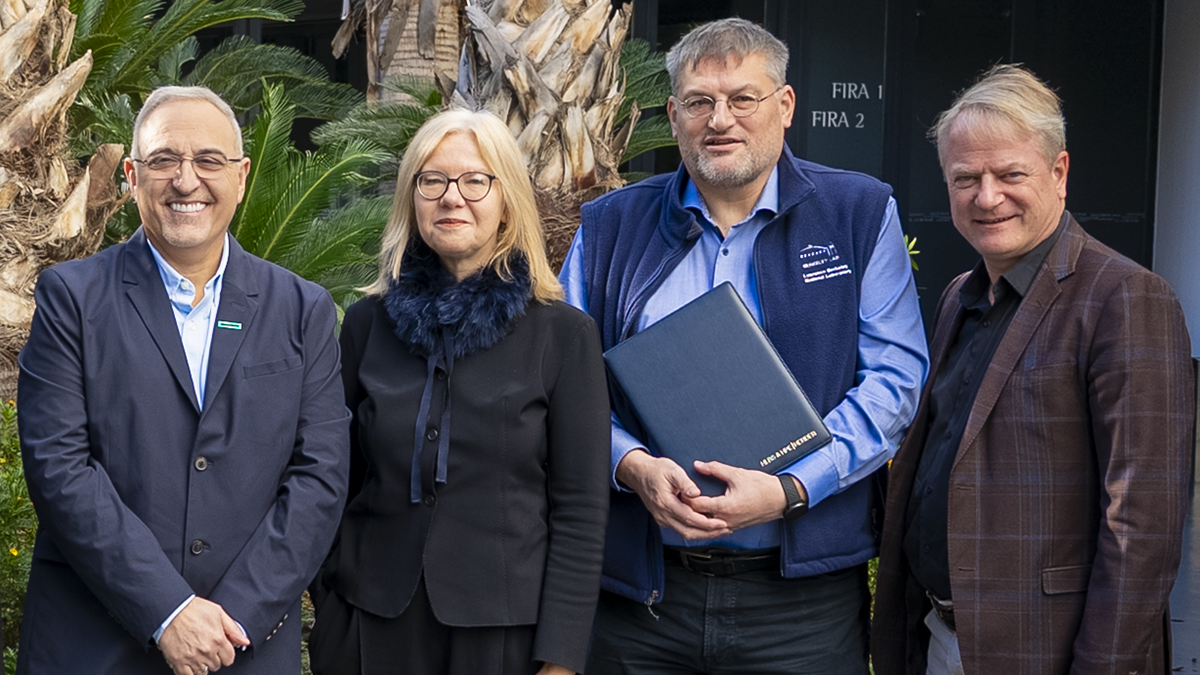
From left to right: Antonio Neri (President and CEO, HPE), Anna Steiger (Rector, University of Stuttgart), Prof. Dr. Michael Resch (Director, HLRS), and Marc Fischer (Managing Director and Vice President Global Sales Germany, HPE). Photo: HPE
The High-Performance Computing Center Stuttgart (HLRS) – one of Germany’s three national supercomputing centres within the Gauss Centre for Supercomputing (GCS) – together with its technology partners Hewlett Packard Enterprise (HPE) and AMD, today announced the architecture of HLRS’s upcoming next-generation supercomputer. The new system — called Herder — will offer both a major increase in performance and an optimized architecture for today's most advanced computational applications, giving German and European research and industry a powerful new tool for scientific discovery and industrial innovation.
Herder will be based on the HPE Cray Supercomputing GX5000, which is designed to support the kinds of large-scale numerical simulation that are essential within HLRS's user community, as well as data-science approaches for model training and generative AI. Herder will contain next-generation processors from AMD, including the AMD Instinct MI430X and AMD EPYC Venice CPU. With this advanced architecture, HLRS anticipates that Herder will achieve performance of more than seven times that of its current flagship system, Hunter.
Prof. Michael Resch, Director of HLRS, celebrated the announcement, saying, "Herder will offer HLRS's scientific and industrial user communities state-of-the-art technologies for both high-performance simulation and artificial intelligence. Combining these capabilities on a single system will also support some of today's most exciting computational research, which is bringing numerical simulation and AI together in extremely interesting ways. Herder will enable our users to simulate systems at a degree of precision and at a scale that is unprecedented in Stuttgart, while also offering local, sovereign capacity for AI model training and generative AI. We are excited about the kinds of results that it will make possible."
Delivery of Herder is scheduled for the second half of 2027 and it is expected to go into service by the end of 2027. It will replace Hunter.
Energy efficiency and sustainability
This jump in performance means that Herder will use substantially more power than Hunter, and so energy efficiency and sustainability have been key considerations in its planning. The system will be housed in a new data center that is currently under construction at HLRS and has been designed with sustainability in mind. The building, called HLRS III, will be accompanied by a new power plant and waste heat management facility. The waste heat that Herder generates will be captured and distributed to other buildings on the University of Stuttgart's Vaihingen campus. This will contribute significantly to the University's decarbonization efforts.
Herder will be used for research across a wide range of disciplines, including computational engineering, physics, chemistry, climate science, and biomedicine. It will power advances in basic science, enable industry to develop better products, and support the public sector in efforts to address global challenges.
For more detailed information please visit: https://www.hlrs.de/news/detail/hlrs-announces-details-of-herder-supercomputer
////////////
Funding for the Herder and Hunter supercomputers is provided by the German Federal Ministry of Research, Technology and Space through the Gauss Centre for Supercomputing, and by the Baden-Württemberg Ministry for Science, Research and Arts.