


RESEARCH HIGHLIGHTS
Our research highlights serve as a collection of feature articles detailing recent scientific achievements on GCS HPC resources.
JSC Partners with NIVIDA for Record-Breaking Quantum Simulation on Classical Supercomputer
Research Highlight –
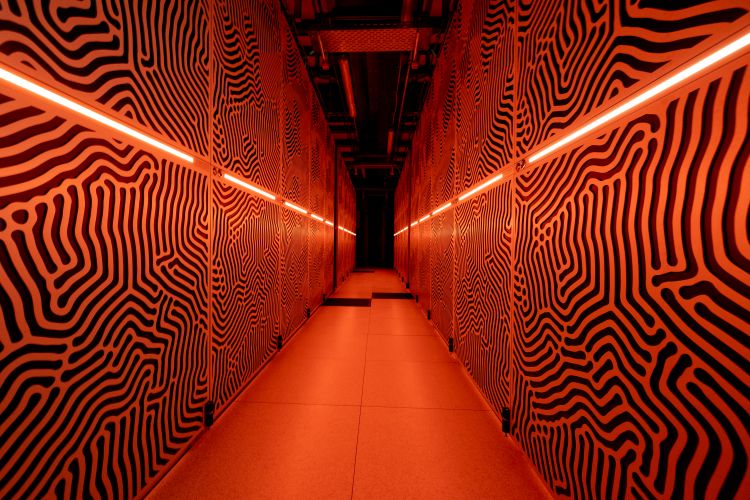
The JUPITER supercomputer at JSC. Image credit: Forschungszentrum Jülich/Sascha Kreklau.
In late 2025, researchers from the Julich Supercomputing Centre (JSC) together with NVIDIA achieved a quantum computing milestone – the team was able to fully simulate a universal quantum computing system with 50 qubits, breaking the previous record of 48 qubits simulated by Julich researchers and their Japanese counterparts on Japan’s K supercomputer in 2019. The team used JSC’s JUPITER supercomputer, Europe’s fastest high-performance computing (HPC) system and the first in Europe to cross the exascale threshold, for its achievement.
“Building a quantum computer is incredibly expensive and the hardware is still very noisy and prone to errors,” said Dr. Hans De Raedt, researcher in JSC’s Quantum Information Processing (QIP) group and collaborator on the project. “HPC-based simulators can act as a perfect flight simulator. They allow us to test their ‘flight plans,’ meaning the quantum algorithms, in a controlled environment where we know exactly what the answer should be. This helps us separate errors in the algorithm from errors in the hardware.”
The work was born out of JSC researchers’ interest in preparing a new version of the Julich Universal Quantum Computer Simulator (JUQCS) that could take full advantage of JUPITER’s new heterogeneous computing architecture that uses NVIDIA’s Grace CPUs and Hopper GPUs for its GH200 superchip architecture. While JUPITER offered a massive performance increase, it also presented a new porting and scaling challenge for the research team.
Memory and data topography challenge simulating quantum systems
Simulating a quantum system gets complicated quickly. In a quantum system – be it qubits in a quantum computer or subatomic particles interacting in space – researchers must account for the superposition of each qubit or particle. For particles, that usually means that researchers must consider that each particle represents a positive and negative charge simultaneously. Accordingly, researchers must represent qubits behaving as the computational binary of one and zero at the same time. De Raedt explained that each qubit possibility takes computational memory, meaning that tracking one qubit might only require a computer to keep up with two possibilities, but 10 qubits requires tracking 1,024 distinct possibilities, and 50 qubits requires tracking more than a quadrillion possibilities at once.
To simulate this large, complex system, researchers are essentially creating a massive spreadsheet that tracks each possible mix of ones and zeroes and updates the likelihood of each outcome based on how gates – the elementary operations of a quantum computer – change them during a simulation. The team used 4,096 nodes of JUPITER and created more than a petabyte of data that needs to be readily accessed by the system’s memory. In fact, memory is one of the primary challenges in simulating larger volumes of qubits. “Since so much data cannot fit on a single chip, we must chop up the data and spread it across thousands of JUPITER’s nodes, and we orchestrate data movement so that when gates need to interact with different parts of the data, they can find them without creating a ‘traffic jam’ on the system’s network,” De Raedt said.
To solve the data management problem, JSC and NVIDIA researchers improved JUQCS to operate more efficiently on either GPUs or CPUs and developed a novel memory compression technique that reduced memory requirements eight-fold. The new JUQCS version, JUQCS-50, will serve as a major foundational piece in JSC’s quantum user facility, the Julich UNified Infrastructure for Quantum computing (JUNIQ).
JUQCS-50 as research tool and benchmark
Unlike a prototype quantum system, JUQCS offers researchers the ability to peer inside the “black box” of a quantum computer. De Raedt indicated that due to the hardware’s sensitivity, trying to measure qubits inside a physical quantum computer causes the system state to collapse. This “noise” can come from programming, but also from vibrations to the system or other physical disturbances. Having the ability to accurately simulate an entire 50-qubit system allows researchers to analyze patterns and find correlations in the system in a way that is impossible on real hardware.
Further, because the team added artificial noise into the simulation, scientists can study how these disturbances impact a quantum system’s ability to deliver clear, coherent results. Researchers can then compare simulations of noisy systems to one operating perfectly to better identify weak points in hardware design.
JUQCS-50 also serves as a powerful benchmarking tool for future quantum systems. De Raedt indicated that proving quantum supremacy means that a quantum system needs to clearly demonstrate it can do something that a classical computer cannot. This requires not only moving beyond relatively modest qubit counts, but also being able to benchmark gate fidelity and throughput – essentially the processing speed of a quantum computer. “If JUQCS can calculate a specific circuit in 10 minutes, a real quantum system needs to be able to do this with high accuracy in seconds to be a viable alternative to the current state-of the-art in classical computing,” he said.
For the moment, JUQCS-50 provides users at the JUNIQ facility access to a powerful tool to serve as a digital twin of a 50-qubit quantum system. “The future isn’t just a simulator; it is a supercomputer with a quantum chip attached to it,” he said. “We are exploring the integration of JUQCS into hybrid workflows at the center, and we already have several applications where our HPC system and quantum processors can work in a loop. We want to keep optimizing how our simulator handles these interactive tasks on JUPITER, ensuring the classical system’s data processing bottleneck is minimized when we eventually swap the simulator for a physical quantum processing unit.”
-Eric Gedenk
To learn more about JUNIQ, please visit: https://www.fz-juelich.de/en/jsc/systems/quantum-computing/juniq-facility
This story originally appeared in the Spring, 2026 issue of InSiDE magazine.