


RESEARCH HIGHLIGHTS
Our research highlights serve as a collection of feature articles detailing recent scientific achievements on GCS HPC resources.
Slick Science: Researchers Use HPC to Uncover Self-Lubrication of Ice
Research Highlight –
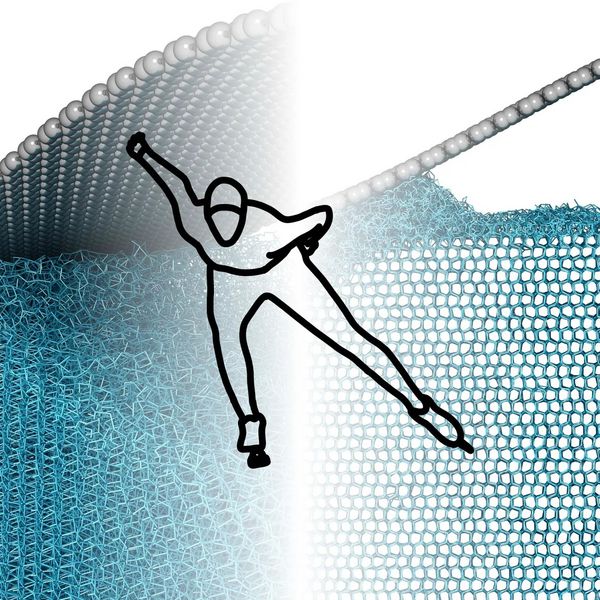
Using the JUWELS Booster, Prof. Martin Müser and his collaborators have uncovered the true reason why we are prone to slip on ice when it is well below freezing. The findings have implications for winter sports such as skiing and ice skating. Image credit: Martin Müser.
For those living in colder climates, wintertime means heavy jackets and layers of warm clothes, hot beverages, and the risk of slipping on ice when stepping onto the street. For over 100 years, researchers assumed that even if the temperature outside was well below freezing, some combination of the pressure from our weight and heat generated through friction melted just enough ice to create a slick, liquid glaze on top of the ice.
Recently, a research team led by Prof. Martin Müser from Saarland University decided to test that theory with the help of high-performance computing (HPC). Using the JUWELS Booster supercomputer at the Jülich Supercomputing Centre (JSC), Müser and his collaborators found that changes to the underlying molecular structure of ice were the culprit, contradicting our understanding of this phenomenon. “What we found was that, basically, ice starts to act like a liquid without being hot,” Müser said. “Ice is made up of uniform crystal structures, and while the temperature increases with friction from our shoes, it isn’t enough to cause melting. It is a mechanical action that destroys ice’s crystalline structure, turning it into an amorphous, liquid-like structure—I would not exactly call it liquid because it remains below a freezing temperature—that we ultimately slip on.”
The team released its findings in Physical Review Letters, which not only put a finer point on the need for crampon shoes to effectively traverse ice, but also could support designing better ice cleats. And on a grander scale, these results could ultimately inform how to improve computational models of glaciers’ movement.
Ice dynamics at the molecular scale
When using modeling and simulation to predict friction between materials, engineers build a large, fine-grained grid and solve equations, which requires knowledge of how the system behaves at the smallest scales. However, if they do not want to rely on potentially false assumptions, researchers must often account for the dynamics of individual molecules. Müser further pointed out that while understanding the forces and interactions between surfaces at the molecular scale is essential and of obvious benefit to understanding friction, researchers also need to see the big picture. “I have learned over time that many interesting things are happening within the bulk of a material system due to forces applied to the surface,” he said. “A full understanding of friction cannot be achieved at the smallest scale alone, because many mechanisms—such as the plasticity of the material—only appear at larger scales.”
In the case of ice and water molecules, Müser’s team needed to model individual molecular interactions in a large enough system to observe bulk effects, which meant they needed access to HPC. With access to the JUWELS Booster at JSC, Müser and his collaborators started by studying atomic interactions of ice against ice at 10 Kelvin, which is roughly negative 260 degrees Celsius. While the team expected to find nearly frictionless motion between the ice, it found that at these extremely cold temperatures, the motion between the layers removed certain molecules, increasing instability and ultimately leading to more amorphization of the ice, creating a disordered interface. This finding showed the team that another mechanism was likely responsible for creating slick surfaces.
He indicated that water molecules are dipoles, meaning that the molecules are negatively charged near their oxygen atom and positively charged near their hydrogen atoms. In three-dimensional structures, if the molecular bonds start to break apart, it creates a cascading effect that impacts the stability of molecules nearby. “When you have dipoles in a three-dimensional system, these molecules cannot really make all of their neighbors happy,” Müser said. “They produce something that a condensed matter physicist would call a frustrated interaction. Once the amorphization of ice starts, it creates conditions that entice other dipole molecules to shift their configurations, which triggers the onset of more disorder.” The team wanted to see if it saw the same behavior in real-world conditions and ran another suite of simulations at negative 10 degrees Celsius. It saw these same mechanical disruptions driving the creation of the amorphous structure at the interface between the bulk ice and forces pressing down on it.
With this finding, Müser indicated that humans would need to continue to rely on mechanical solutions such as ice cleats that provide additional support getting the traction necessary not to slip. He also pointed out that a long-held myth in winter sports—that skiing in deeper cold is more difficult because there wasn’t enough of a liquid film forming—was not correct based on his team’s research. The liquid still forms, but quickly converts back to ice, or, at extremely low temperatures, eventually becomes as highly viscous as honey.
HPC advancements support researchers’ quest to answer larger questions in materials science
In his research using JSC resources, Müser’s previous simulations have been among the largest of their type—roughly 100,000 by 100,000 surface elements in a simulation. These simulations are large enough for the research team to gain meaningful insights on friction dynamics, but they are still time consuming. Using 10,000 computing cores on the JUWELS Booster means that the team is still calculating roughly one million atoms per core.
Müser indicated that the team was using a combination of artificial intelligence and JSC user support to port the team’s codes to run efficiently on GPUs, which will accelerate some of the intensive number crunching necessary in these calculations. “I have been in the process of rewriting some things in my code, and with the help of AI, it is easier than ever to have support in how to lay out my code,” he said. “While AI can help a lot with rewriting codes, I still need the real support of JSC’s experts to port this effectively to a big machine. In fact, one of my recent optimizations came out of a conversation that I had with a colleague at JSC and having that support for parallelizing parts of a code is huge for us.”
In addition to continuing to study friction dynamics, Müser indicated that access to JSC’s latest flagship system, JUPITER, would allow him and his collaborators to go after even more complex research questions in the future. The team had ideas for new computing proposals that include developing improved lubrication processes for wind turbines and deeper studies on why the Earth is negatively charged and celestial objects are positively charged.
-Eric Gedenk
Related publication: Atila, A. S. Sukhomlinov, and M. Müser (2025). “Cold Self-Lubrication of Sliding Ice,” Physical Review Letters 135. DOI: https://doi.org/10.1103/1plj-7p4z
Funding for JUWELS was provided by the Ministry of Culture and Research of the State of North Rhine-Westphalia and the German Federal Ministry of Research, Technology and Space through the Gauss Centre for Supercomputing (GCS).