


NEWS
Stretching Our Understanding of Spheroidal Particles
Research Highlight –
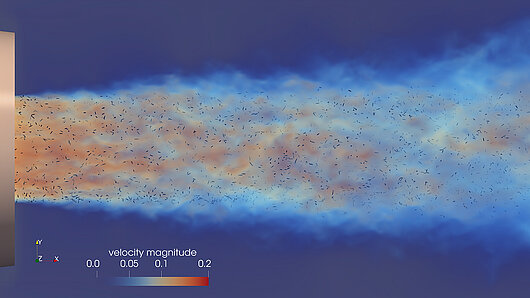
Visualization of a particle-laden jet flow. The orientation of the point-particles is visualized through ellipsoidal glyphs. Image: AIA
Understanding how fluids and particles behave during turbulent flows remains one of physics’ greatest challenges. RWTH Aachen University’s Institute of Aerodynamics and Chair of Fluid Mechanics (AIA) is among the world’s leading institutions for studying turbulence in engineering flows. For many years, the institute has used high-performance computing (HPC) resources at the High-Performance Computing Center Stuttgart (HLRS) to model turbulent flows computationally.
Typically, such simulations have assumed that particles are spherical in shape. In recent papers, however, the AIA team has been investigating the effects of other particle shapes, such as ellipsoids, on simulations of particle interactions. These shapes are more often found in the context of biomass combustion, a scalable, cleaner alternative to coal-fired power plants.
“The institute has been working on this problem for several years before I arrived as a graduate student, and it is clearly motivated by what we see in nature,” said Laurent André, graduate researcher at AIA. “Most particles we see in nature are not perfectly spherical, but most modeling approaches assume spherical particle shapes. We are investigating the impact of this assumption — how valid is it? When does this assumption start to impact the accuracy of a model?”
André and recent PhD graduate Dr. Thede Kiwitt worked closely with Professor Wolfgang Schröder, Head of AIA, and Dr. Matthias Meinke, Head of Numerics at AIA, to evaluate various modeling approaches for ellipsoidal particles and run high-fidelity simulations to improve their accuracy.
Accurate modeling leads to better simulation
When researchers use computers to simulate turbulent flows, they must either include models that inform how certain particles behave or solve equations for each particle interaction during each time step. The direct simulation of particles without model assumptions is called direct particle-fluid simulation (DPFS). Although DPFS is prohibitively expensive for even modest system sizes, researchers have been able to increase the scale of direct particle-fluid simulations as computers have gotten more powerful.
In fact, AIA researchers in January 2026 published a paper in the International Journal of Multiphase Flow, where they focused on doing DPFS of both spherical and ellipsoidal particles through pipes and jets. DPFS solves the particles’ flow field directly, meaning that the boundaries and behaviors of each individual particle are numerically resolved without any additional model.
Although the flow problem was relatively simple compared to real-world conditions, the team still needed 1.3 billion cells to simulate approximately 80,000 particles. The team demonstrated that although most particles were represented as spheres in such simulations, non-spherical particles behaved significantly differently. Specifically, they discovered that ellipsoidal particles with larger aspect ratios — the ratio of length to width in a particle — move further towards the center of a pipe compared to spherical particles. In the jet flow, the concentration peaks of particles with larger aspect ratio move farther off the centerline. The team used both HLRS’s Hawk and Hunter supercomputers for its direct particle-fluid simulations.
Most scientists and engineers do not have access to the computational power needed for DPFS simulations, however. For this reason, André has been evaluating and improving models of particle flow produced using high-performance computing. These models can be integrated into less computationally demanding types of fluid-particle flow simulations called large-eddy simulations (LES). LES numerically calculates particle behavior at the larger turbulence scales but represents the impact of smaller eddies on the fluid-particle mixture in models. This makes LES more accessible for researchers who do not have access to large-scale supercomputers, including in industry.
André and his predecessors have worked with the team on evaluating point-particle models that can improve the accuracy of fluid-particle simulations. In point-particle models, researchers assume that particles have a consistent mass, even if they have different shapes. This simplifies the problem, making it possible to concentrate computational resources on simulating particle-fluid interactions.
Using HLRS resources, André and his collaborators evaluated three different point-particle models: a model with spherical particles, a model with ellipsoidal particles, and a model that includes ellipsoidal particles in a more complex system. This third category better accounts for their different behaviors regarding lift, drag, and torque. The team found not only that the point-particle model with additional physics outperformed the others, but also that it showed good agreement with more expensive direct particle-fluid simulations in terms of the preferential particle orientation in the free-jet. The team published its results in the journal Fuel.
Toward the simulation of realistic combustion conditions
The team’s efforts to improve fluid-particle models lays a foundation for larger simulations that could realistically represent particle-laden combustion processes. While researchers at AIA have a long track record of simulating single and multi-phase flows, next-generation HPC systems offer the chance to improve these simulations on a fundamental level. “Our simulations so far are really reference simulations, as they are not yet at the scale to use in an industrial context,” André said. “With access to leading HPC sources, we can increase the level of detail. This will be necessary to produce the highly resolved data we need to develop more accurate models, which will offer industry more reliable predictions.” In this way, the team’s simulations will continue to improve LES done in academic and industrial settings.
With continued access to leading HPC systems like those at HLRS, the team also aims to run DPFS at an increasingly large scale. Because of the size and complexity of the system, DPFS for an entire biomass reactor is still computationally impossible. With its current allocation of HLRS resources, however, the team is now focused on how to further improve point-particle models to better account for particle orientation and rotation during a simulation.
— Eric Gedenk
Funding for HLRS's Hawk and Hunter supercomputers was provided by the Baden-Württemberg Ministry for Science, Research, and the Arts and the German Federal Ministry of Research, Technology and Space through the Gauss Centre for Supercomputing (GCS).
Related Publications
André L, Kiwitt T, Meinke M, et al. 2027. Comparison of point-particle models and direct particle-fluid simulations for non-spherical particles. Fuel 427: 139560.
Kiwitt T, Meinke M, Krug D, et al. 2026. Direct particle-fluid simulation of spherical and ellipsoidal particles in turbulent pipe-free-jet flow. Int J Multiphase Flow. ePub Jan 1.