


ASTROPHYSICS
Cosmic Turbulence and the Mystery of Mega Radio Halos – Solved by Supercomputers
Principal Investigator:
Dr. Franco Vazza
Affiliation:
Universität Hamburg, Hamburger Sternwarte, Hamburg, Germany
Local Project ID:
breakthru
HPC Platform used:
JUWELS CPU at JSC
Date published:
Introduction
Mega radio halos are Millions of light years extended and faint radio sources which illuminate the rarefied medium at the extreme periphery of clusters of galaxies, which have been discovered only in 2023 and whose origin is unknown.
Using high-resolution simulations performed on the JUWELS supercomputer, researchers from the University of Bologna might have for the first time modelled how such giant emission regions might form, based on the idea that the turbulence of present in between galaxies can give a fraction of its energy to electrons, making them moving at the speed of light and emit synchrotron radiation on scales never seen before.
Project
A new generation of radio observatories, like LOFAR (https://www.astron.nl/telescopes/lofar/), is reshaping how we see the Universe and it keeps expanding the number of mysterious sources astrophysicists have to explain. One of the biggest mysteries in recent years has been the discovery of "mega radio halos": vast and faint regions of radio emission that stretch across millions of light-years in some galaxy clusters, and which cannot be explained by any known process so far. Now, thanks to cutting-edge cosmological simulations run on Germany’s JUWELS supercomputer, researchers might have shed an important light on their formation process.
“Classical” Radio halos—huge, diffuse glows of radio waves in galaxy clusters—have been known for decades. But “mega" radio halos, recently discovered with low-frequency observatories like LOFAR, are far larger and dimmer, and they raised many questions about whether they arise from entirely different processes. Are these mega structures an entirely new phenomenon, or just the extreme end of the same cosmic mechanism?
To find out, researchers from the University of Bologna (e.g. Luca Beduzzi, Franco Vazza and collaborators in a series of papers published in Astronomy & Astrophysics) turned to high-performance computing using JUWELS in Juelich, to produce ambitious new simulations of the evolution of clusters of galaxies as they merge and grow their mass, with the public cosmological code ENZO (enzo-project.org).
At the heart of their investigation was the modelling of cosmic-ray electrons: high-energy particles that emit radio waves as they spiral through large enough magnetic fields. These electrons lose energy quickly, so something must be constantly recharging them. These new works combined the new cluster simulations produced on JUWELS with a new code developed specifically for solving the evolution of these electrons: the researchers called it “Roger” since it was meant to be elegant, fast and accurate as the greatest tennis player of all times!
What they found was striking. As their simulated clusters merge, they stir up intense turbulence in a cosmic storm, and a fraction of this energy re-energises electrons across vast regions of space. This "turbulent re-acceleration" process, especially in chaotic, magnetised regions, produces radio halos that closely match what is seen in the real universe. But even more: in some directions, the simulated radio glow stretched even farther than expected, mimicking the size and spectrum of the mega radio halos recently discovered by LOFAR.
These findings suggest that both types of radio halos may be powered by the same fundamental process: turbulence generated during cluster mergers. The distinction between "normal" and "mega" halos may be more about perspective, timing and environment than different physics.
Without the computational power enabled by JUWELS, such detailed modelling would have been impossible, and testing the theory just using simpler analytical calculations would have prevented the discover of the time-dependent and intermittent conditions that appear necessary for the formation of mega radio halos. This is a perfect example of how astronomy today is not only about looking deeper into space, but also computing harder on Earth.
As radio telescopes like Square Kilometre Array (https://www.skao.int/en) come online, the Universe will reveal more secrets, and hopefully thanks to simulations like these, astronomers will be ready to understand them.
For more information, see the full study inAstronomy & Astrophysics: https://ui.adsabs.harvard.edu/abs/2024A%26A...690A..67B/abstract
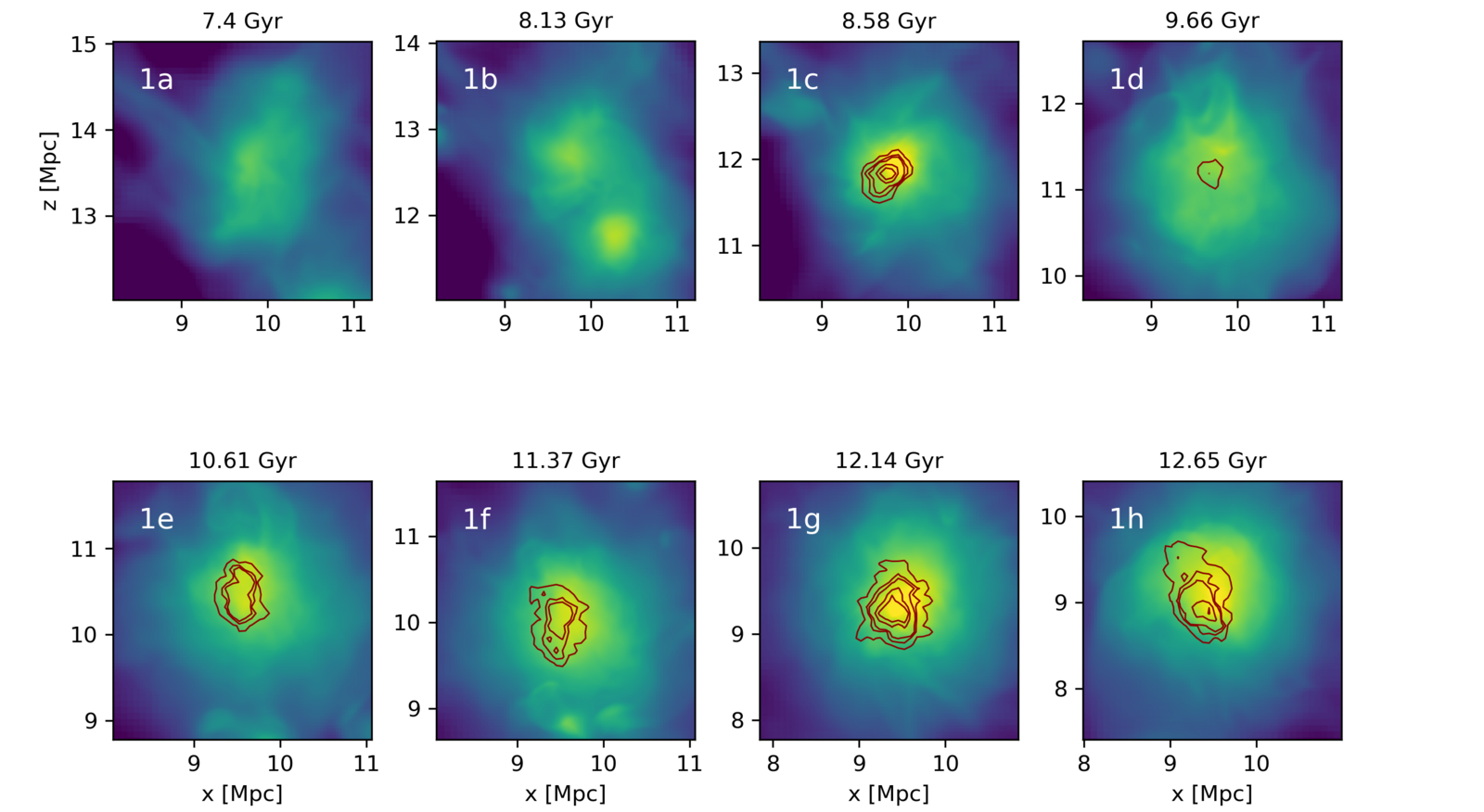
Caption: evolution of the gas distribution of a simulated cluster of galaxies across time (from the age of 7.4 billions of years to 12.65 billions of years), and of the distribution of observable radio emission observable with LOFAR (contours), taken from Beduzzi et al. 2024, A&A).