


ASTROPHYSICS
Impact of Stellar Feedback and Galactic Dynamical Effects on the Star Formation Rate in Dwarf Galaxies
Principal Investigator:
Prof. Dr. Stefanie Walch-Gassner
Affiliation:
Universität zu Köln, I. Physikalisches Institut, Köln, Germany
Local Project ID:
dwarfgal
HPC Platform used:
JUWELS CPU at JSC
Date published:
Abstract
Dwarf galaxies are the smallest and most numerous galaxies, offering a clear view of fundamental astrophysical processes. Their shallow gravitational potentials make them highly sensitive to stellar feedback, helping us understand how feedback processes regulate star formation and the development of the multi-phase interstellar medium (ISM). They also preserve clues about early galaxy formation, chemical enrichment, and the nature of dark matter, serving as vital laboratories for testing cosmological models. In this project simulations of dwarf galaxies were performed to investigate the impact of stellar feedback and of the galactic environment including e.g. shearing motions on the ISM. The dwarf galaxy simulations are compared with state-of-the-art simulations of stratified ISM patches that do not include the galactic environment.
Introduction
The interstellar medium (ISM) describes the gas, dust and radiation that exists in the space between stars. It contains dense structures such as filaments and molecular clouds which are the birthplaces of stars and it is the bridge linking galactic and stellar scales. Hereby, the ISM regulates the flows of gas mass and energy from the galactic to the stellar scales and back. On the computational side, a lot of progress has been made over the last decade to include the relevant physical processes, such as chemistry, star formation, stellar winds, supernovae, radiative transfer and cosmic ray transport. Accurately modeling and understanding the evolution of the ISM is thus not trivial but important to understand where and how stars are born. Due to their small physical size, dwarf galaxies allow for a detailed modeling of star formation and the ISM on galactic scales. Additionally, they are of high astrophysical relevance, as outlined above.
Methods
The general framework of the performed simulations are build upon the work of the project “Simulating the Life-Cycle of molecular Clouds” (SILCC) [1, 2] from the Theoretical Astrophysics Group in Cologne. The SILCC project is based on the (magneto-)hydrodynamical code FLASH [3]. Additional physics modules include a chemical network, radiative transfer, self-gravity, and stellar feedback from massive stars in the form of ionizing radiation, stellar winds, supernovae and cosmic rays [4, 5].
The initial dwarf galaxies are set up according to observed relations between the halo mass and stellar mass as well as the stellar mass to gas mass. The galaxies’ gas distribution is initialized in vertical hydrostatic equilibrium and is stabilized by galactic rotation in the radial direction using an in-house developed tool [6]. The new tool prevents an early starburst and allows for improved simulations.
Star formation is followed with sink particles, which are formed once the gas has reached a critical density threshold and fulfills extra criteria such as being collapsing and being gravitationally bound. The mass within the sink particles is considered to be stellar mass, with one massive star (>8 MSun) being formed for every 120 MSun of accreted gas mass. In Figure 1, a volume rendering of gas density is shown where the location of the stellar clusters are visualized as spheres.
Results and Outlook
All three simulations start off with a smooth density distribution. To introduce density structures and turbulence into the medium, supernovae are placed in the simulation based on the initial gas distribution. This helps the formation of structures within the galaxy. Once the gas density has reached a critical density, stellar clusters are forming which are visualized as black points in Figure 2. After the star formation has set in, the massive stars located in the stellar cluster exert feedback onto the surrounding gas. The time evolution in Figure 2 shows how the gas is strongly disrupted once the stellar clusters are forming. Hereby, the supernovae play a major role as they inject a large amount of energy and can drive the gas out of the galactic disk.
From the evolution of the galaxy as well as the stellar clusters, one can determine the star formation rate (SFR) at different radial positions and plot them on a Kennicutt-Schmidt type diagram [7] (see Figure 3). All three galaxies combined cover about two magnitudes in surface densities (as can also be seen in Figure 2). Hereby, the radial SFRs follow roughly the predicted slope. For comparison, SFRs from the SILCC VII [5] simulations are included which were run at different initial surface densities. The results of the SILCC and the dwarf galaxy simulations shown an overlap.
Further analysis of the simulations are currently underway, to better understand the influence of the galactic environment on the impact of star formation. For this comparison simulations from the SILCC project will be used to e.g. quantify the impact of galactic shear on the star formation rate.
References
[1] Walch, S. et al. The SILCC (SImulating the LifeCycle of molecular Clouds) project - I. Chemical evolution of the supernova-driven ISM. MNRAS454, 238–268 (2015).
[2] SILCC project webpage: hera.ph1.uni-koeln.de/~silcc/
[3] Fryxell, B. et al. FLASH: An Adaptive Mesh Hydrodynamics Code for Modeling Astrophysical Thermonuclear Flashes. ApJS131, 273–334 (2000).
[4] Rathjen, T.-E. et al. SILCC - VII. Gas kinematics and multiphase outflows of the simulated ISM at high gas surface densities. MNRAS522, 1843–1862 (2023).
[5] Rathjen, T.-E. et al. SILCC - VIII: The impact of far-ultraviolet radiation on star formation and the interstellar medium. MNRAS540, (2025).
[6] Pressure approximation tool: github.com/PierreNbg/FLASH_GalaxyTools/tree/main/pressure_approximation
[7] Kennicutt, R. C., Jr. The Global Schmidt Law in Star-forming Galaxies. ApJ498, 541–552 (1998).
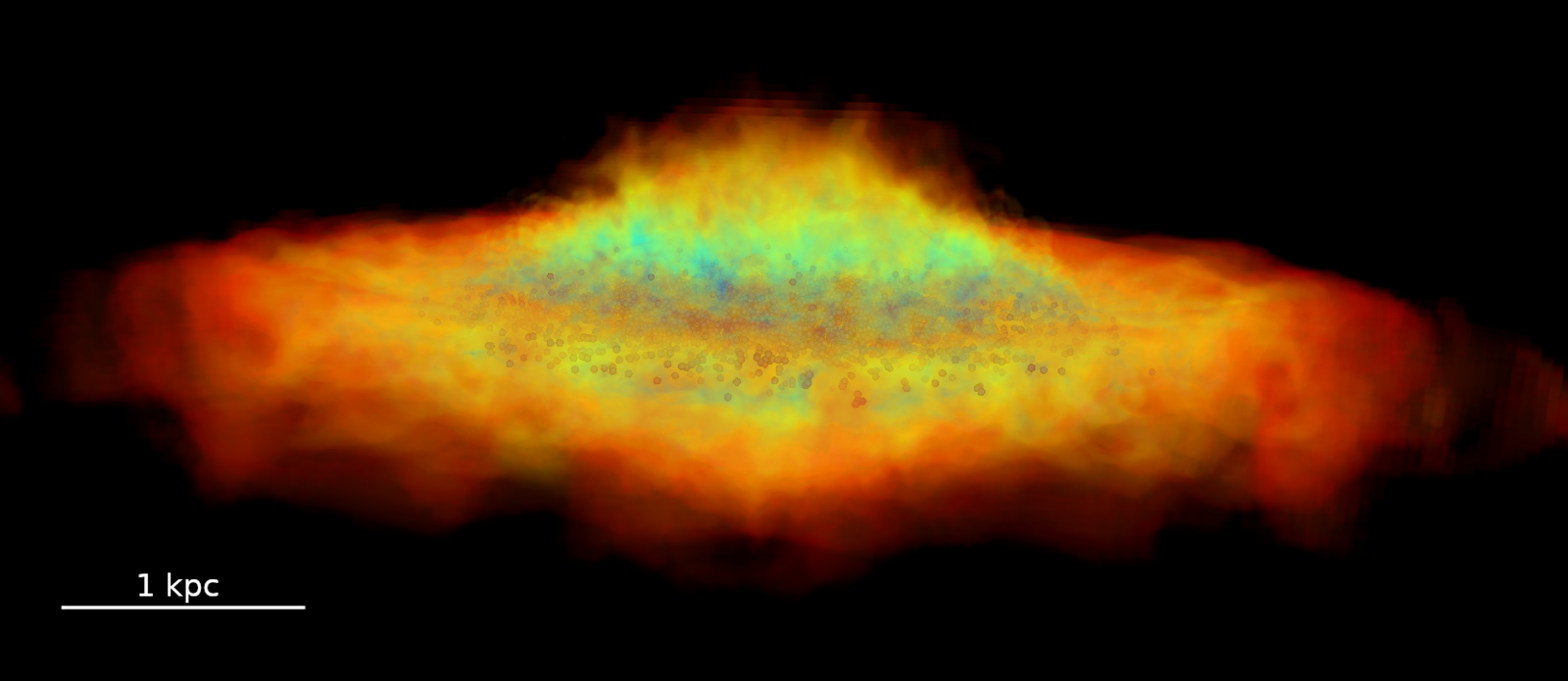
Figure 1: Volume rendering of the gas density produced with the tool COVISE. Stellar clusters are visualized as spheres which are embedded within the galactic disk.
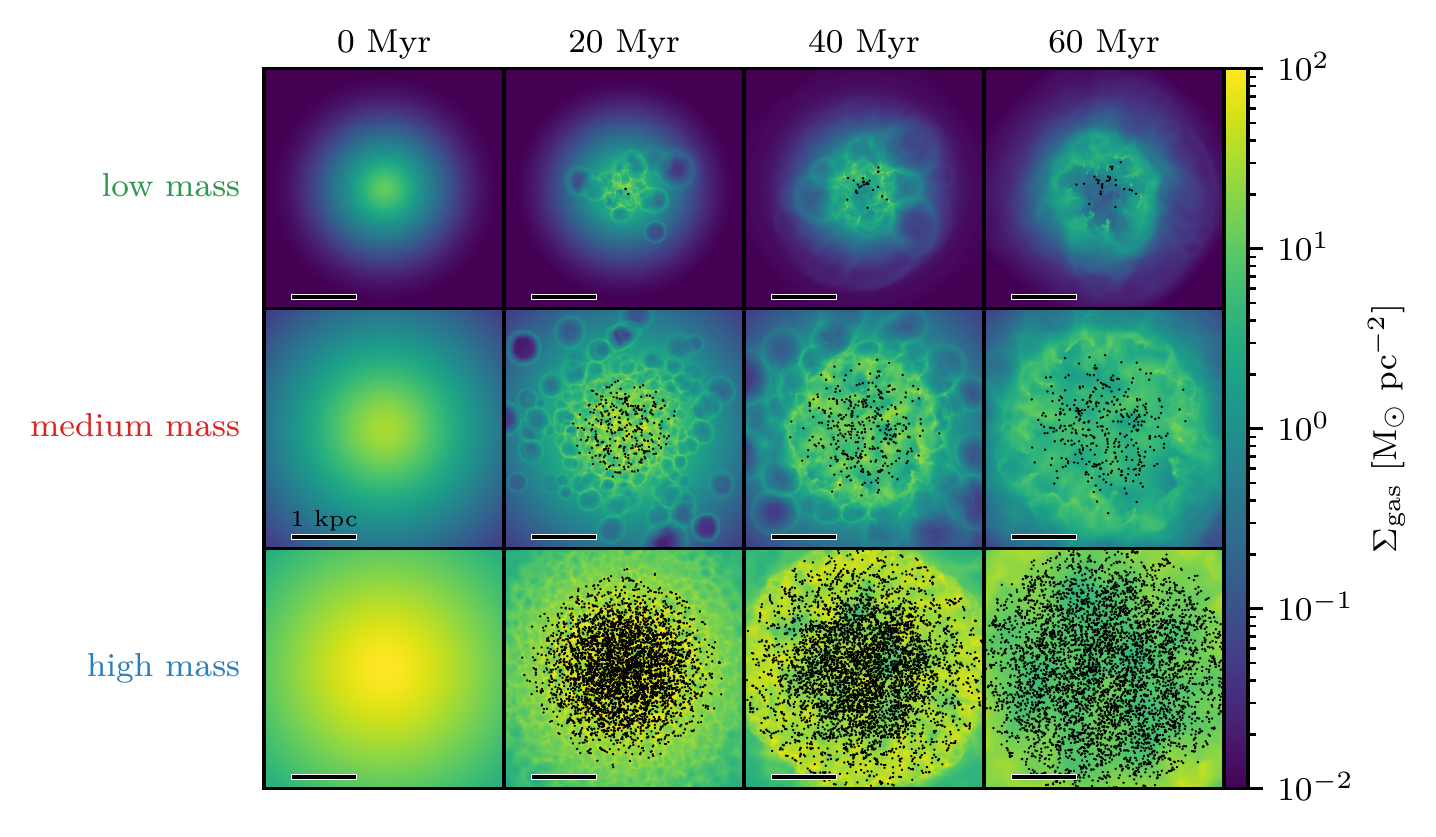
Figure 2: Surface density of all three galaxies for the first 60 Myr of their evolution. The black dots show the position of the stellar clusters which contain massive stars. With increasing galaxy mass the number of stellar clusters increases significantly. The associated stellar feedback from massive stars is evacuating center.
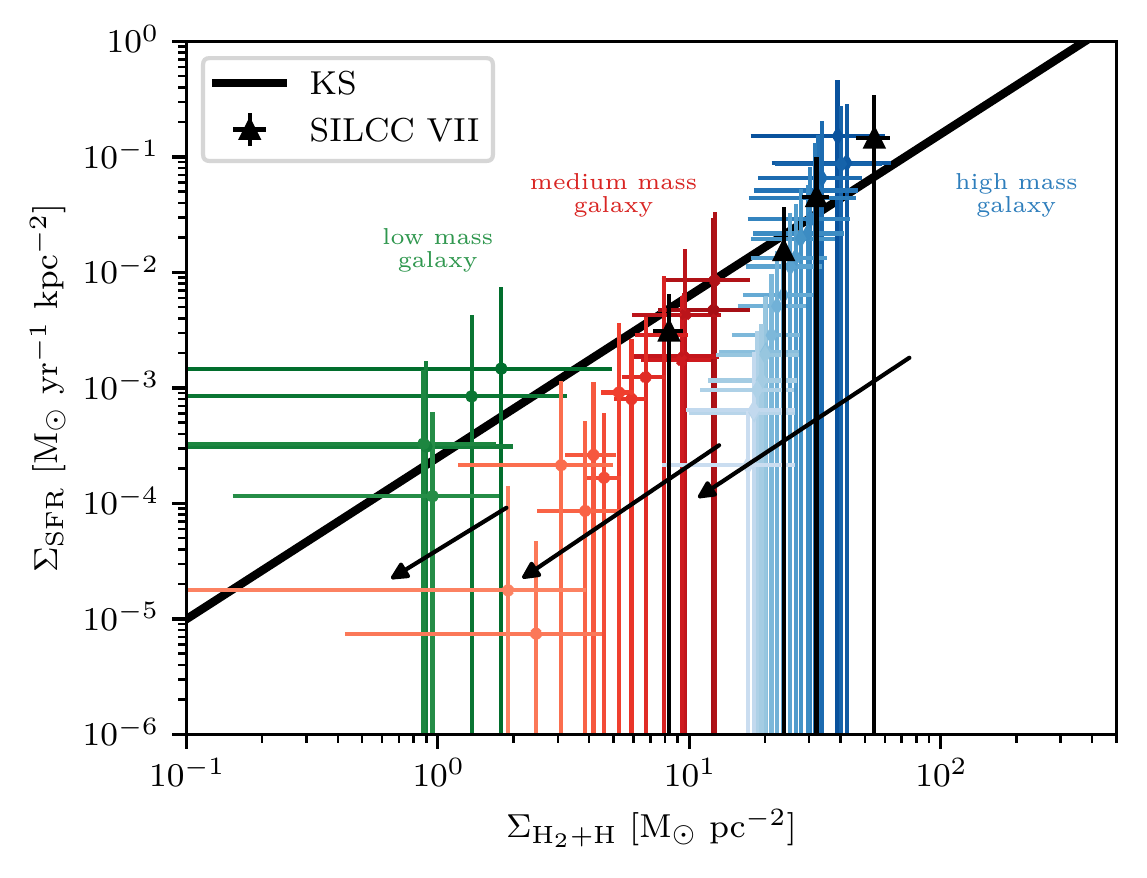
Figure 3: Comparison of the star formation rate surface density with the gas mass surface density. Each point represents one radial bin of 100 pc from the center (darker color) outwards (brighter colors). The direction of the radial bins are also shown with black arrows. Each of the galaxy shows a rough correlation with the observed slope of Kennicutt [7]. Only the high mass galaxy exhibits a steeper slope. On top we show with black markers results from the SILCC VII simulations [4].