


ENGINEERING AND CFD
Supercomputing for Cleaner Energy: Simulating Flames, Fuels, and Future Materials
Principal Investigator:
Prof. Dr. Andreas Kempf
Affiliation:
Universität Duisburg-Essen, Chair of Fluid Dynamics, Duisburg, Germany
Local Project ID:
DUEHAWK2021
HPC Platform used:
Hawk at HLRS
Date published:
Abstract
How can cleaner engines, recyclable fuels, and better battery materials be developed without costly trial-and-error experiments? Researchers at the University of Duisburg-Essen used the HAWK supercomputer to recreate combustion and particle formation processes in unprecedented detail. Their simulations explored hydrogen combustion in engines, recyclable iron fuels, cleaner coal and ammonia combustion, and the formation of nanoparticles for advanced batteries. The project also helped prepare scientific software for the next generation of supercomputers, opening new opportunities for sustainable energy and industrial technologies.
Project
The transition toward cleaner energy systems depends on understanding complex physical processes that are often impossible to observe directly. Flames evolve in fractions of a second, fuel droplets evaporate inside turbulent flows, and tiny particles smaller than a thousandth of a millimeter form under extreme temperatures. Traditional experiments provide valuable insights, but many details remain hidden because the processes happen too quickly or in environments where it is near impossible to take measurements.
To overcome these limitations, researchers at the Chair of Fluid Dynamics at the University of Duisburg-Essen used the HAWK supercomputer at the High-Performance Computing Center Stuttgart (HLRS) to perform highly detailed computer simulations of combustion and particle formation. The project combined several research topics into a common goal: improving energy technologies and industrial processes while reducing emissions and resource consumption.
The simulations focused on some of today’s most pressing technological questions. How can hydrogen be used more reliably in combustors? Can recyclable metal fuels provide a carbon-free energy carrier? How can industrial combustion processes produce fewer harmful pollutants? And how can advanced materials for batteries be manufactured more efficiently?
Answering these questions required calculations far beyond the capabilities of conventional computers. Many of the simulations recreated physical processes down to microscopic scales, involving billions of calculation points and millions of interacting particles [1]. Running a single case often required thousands of processor cores working simultaneously and consumed millions of computing hours.
One major focus of the project was the study of hydrogen combustion in future engines. Hydrogen is considered an important energy carrier because it can burn without releasing carbon dioxide. However, hydrogen behaves differently from conventional fuels: it mixes rapidly with air and burns extremely fast, making combustion difficult to predict and control. Researchers recreated hydrogen injection and ignition under engine-like conditions using highly resolved simulations. These virtual experiments produced reference data that can improve future engine designs and support the development of more reliable hydrogen-powered transportation. [2]
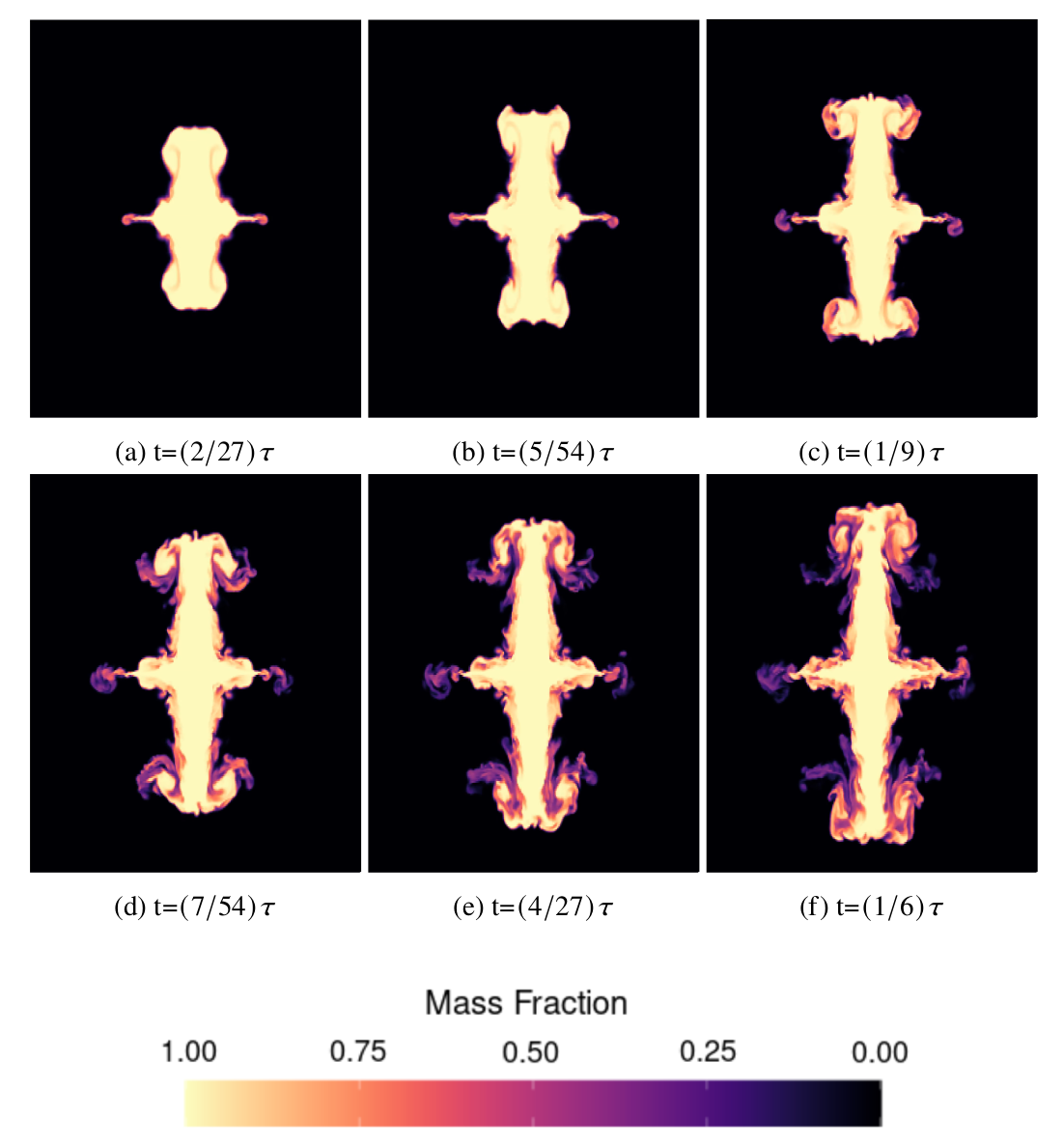
Figure 1: Hydrogen Injection inside the Taylor-Green-Vortex. Theoretical study on hydrogen direct injection for research on internal combustion engines. [2]
The project also investigated alternative fuels for cleaner combustion systems. Researchers studied the co-firing of pulverized coal with ammonia [3], a carbon-free fuel candidate that could help reduce greenhouse gas emissions in industrial applications. Through simulations, they analyzed how flames evolve and how harmful nitrogen oxide (NOx) pollutants form. The results helped identify chemical mechanisms that better predict pollutant formation and could contribute to cleaner combustion technologies in the future.
Another promising area explored in the project involved recyclable metal fuels, particularly iron. Unlike fossil fuels, iron can release energy through combustion and later be regenerated using renewable electricity, creating a potentially circular energy cycle. Yet the detailed behavior of burning iron particles in turbulent environments is still poorly understood. Using advanced simulations, researchers followed millions of individual iron particles as they moved through hot and cold air streams [4]. The calculations revealed how particle size influences ignition and combustion, providing important knowledge for future carbon-free energy storage systems.
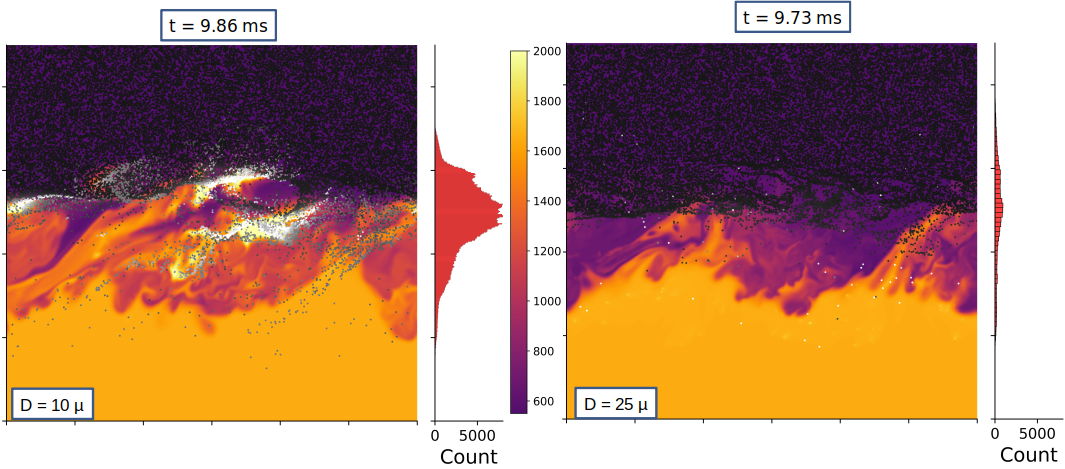
Figure 2: Snapshots of instantaneous gas-phase and particle temperatures, comparing particle sizes of 10 microns and 25 microns to analyze ignition and combustion behavior [4].
Beyond fuels and engines, the project addressed challenges in advanced material manufacturing, especially the production of nanoparticles [5]. Tiny particles made of iron oxide and silicon-based compounds are important for applications ranging from catalysts to battery technologies. In lithium-ion batteries, for example, silicon-carbon nanoparticles could improve energy storage performance.
Producing such particles in industrial reactors is difficult because growth processes occur under rapidly changing temperature and flow conditions. Researchers therefore recreated these environments inside the computer, tracking how particles nucleate, grow, collide, and change under turbulent conditions. The simulations successfully reproduced experimentally observed particle sizes and distributions, allowing scientists to better understand how manufacturing conditions influence material quality. This knowledge may contribute to more efficient industrial production and improved battery materials.
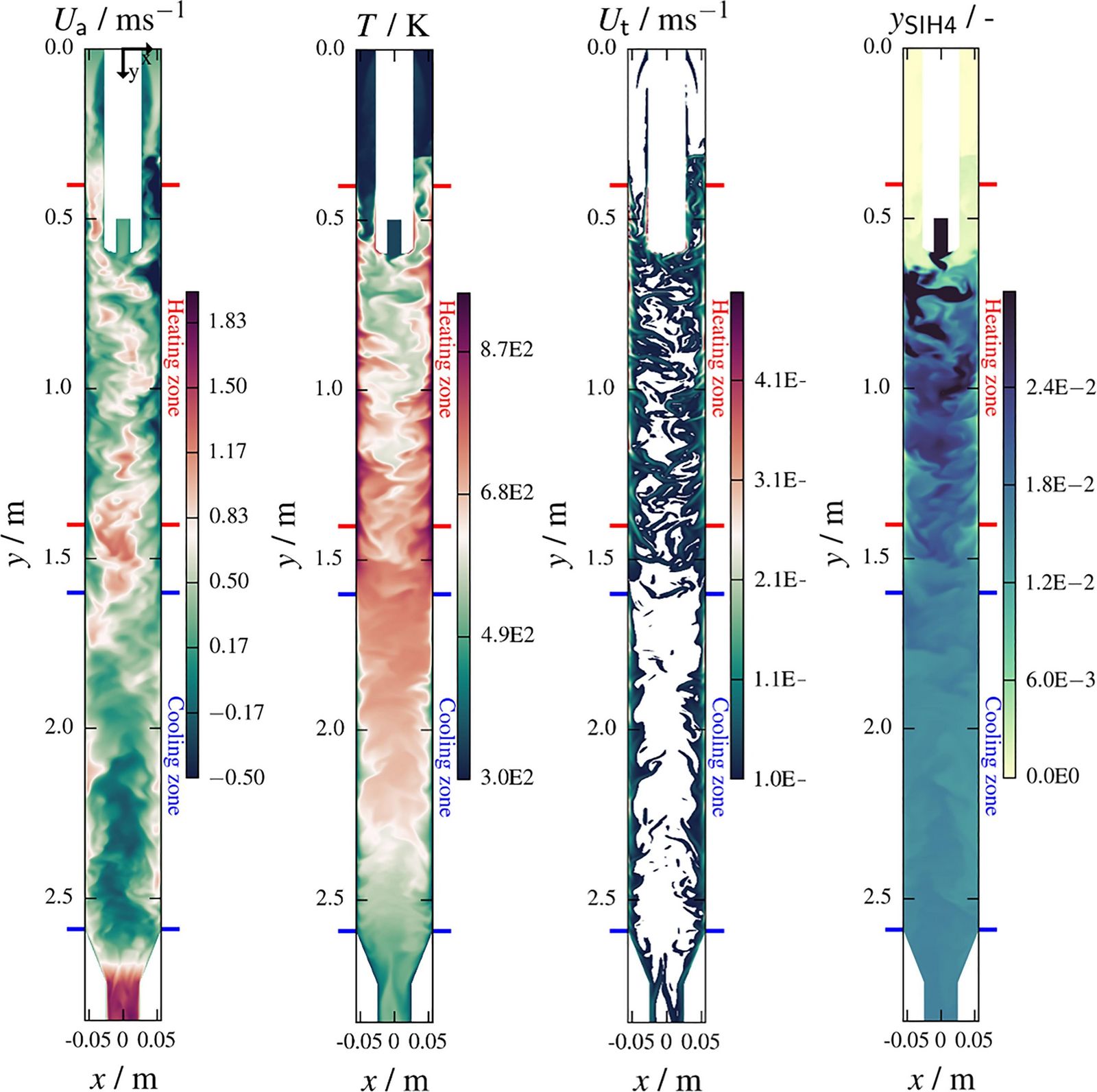
Figure 3: Cross-sectional views (z-normal planes) of key flow quantities predicted by the simulation. From left to right: axial velocity, temperature, thermophoretic velocity, and monosilane concentration. For clarity, the figures are vertically compressed by a factor of 2. – Taken from [5].
The project demonstrated how virtual experiments performed on supercomputers can complement laboratory work. In many cases, simulations revealed details that are inaccessible to measurements, such as internal flame structures, particle transport pathways, or temperature histories inside reacting systems. At the same time, experimental measurements were used to validate the simulations, ensuring that the computer-generated results reflected real physical behavior.
During the project, researchers used approximately 73 million computing core-hours on HAWK. Some simulations involved more than one billion calculation cells and ran simultaneously on tens of thousands of processor cores. Such enormous computational power was essential because many physical processes had to be resolved across multiple scales—from turbulent gas motion to microscopic particle behavior.
In the project’s final stage, attention shifted toward the future of scientific computing. As HAWK approached retirement, researchers began adapting their in-house simulation software, PsiPhi, for HUNTER, HLRS’s next-generation supercomputer. During a dedicated porting hackathon, the team successfully optimized the code for modern accelerated hardware. Early tests showed dramatic improvements in performance and memory efficiency, allowing much larger simulations to run on fewer computing resources. The work completed in this project demonstrates the growing importance of high-performance computing in solving energy and sustainability challenges. Whether improving hydrogen engines, reducing industrial emissions, developing recyclable fuels, or designing advanced battery materials, supercomputers increasingly serve as virtual laboratories where scientists can explore ideas that would otherwise remain out of reach.
As energy systems become more complex and the demand for sustainable technologies grows, simulations like these are expected to play an even greater role in shaping the energy solutions of tomorrow.
References
[1] Linus Engelmann et al. “Numerical analysis of multi-regime combustion using flamelet generated manifolds - a highly-resolved Large-Eddy Simulation of the Darmstadt multi-regime burner”. In: Combustion and Flame 251 (May 2023), p. 112718. ISSN: 0010-2180. DOI: 10 . 1016 / j . combustflame . 2023 . 112718. URL: http://dx.doi.org/10.1016/j.combustflame.2023.112718.
[2] L. F. Rico Cortes, I. Wlokas, and A. Kempf, High Fidelity Simulations of Hydrogen Jet Injection into 3D Taylor Green Vortex for DISI Internal Combustion Engine Analysis, Direct and Large-Eddy Simulation 14 (DLES 2024), April, Erlangen, Germany.
[3] Dominik Meller et al. “Evaluation of ammonia co-firing in the CRIEPI coal jet flame using a three mixture fraction FPV-LES”. In: Proceedings of the Combustion Institute 39.3 (2023), pp. 3615–3624. ISSN: 1540-7489. DOI: 10.1016/j.proci.2022.07.182. URL: http://dx.doi.org/10.1016/j.proci.2022.07.182.
[4] P. Ghofrani, S. H. Tei, I. Wlokas, and A. Kempf, Carrier-phase DNS of iron particle cloud com-
bustion in a highly turbulent shear layer, 12th European Combustion Meeting (ECM 2025), April, Edinburgh, Scotland.
[5] P. Wollny et al. “The role of phase transition by inception and surface reactions for the synthesis of silicon nanoparticles in a hot-wall reactor – Simulation and experiment”. In: Chemical Engineering Journal 463 (May 2023), p. 142348. ISSN: 1385-8947. DOI: 10.1016/j.cej.2023.142348. URL : http://dx.doi.org/10.1016/j.cej.2023.142348.
Project Information
Main Scientific Areas:
- Hydrogen combustion and engine simulations
- Multi-regime combustion
- Recyclable metal fuels / Energy carriers
- Nanoparticle synthesis
- Battery material research
- High-performance computing software development