


ELEMENTARY PARTICLE PHYSICS
Monte Carlo Simulations of Critical Phenomena at Boundaries
Principal Investigator:
Dr. Francesco Parisen Toldin
Affiliation:
Institute for Theoretical Solid State Physics RWTH Aachen University, Aachen, Germany
Local Project ID:
critbdy
HPC Platform used:
JUWELS CPU at JSC
Date published:
Abstract
Critical phenomena occur at the onset of continuous phase transitions, where universality emerges: some observables are independent of the details of the local interactions, and are rather determined by global features, thereby defining universality classes. This project investigates critical phenomena in the presence of surfaces and defects, where rich phase diagrams are anticipated. It includes a quantitative study of the recently discovered extraordinary-log phase in the three-dimensional O(N) model, along with precise numerical estimates of universal coefficients for the three-dimensional Ising model with boundaries.
Background
Critical phenomena refer to the collective behavior encountered at the onset of a continuous phase transition. This type of transitions occurs when the order parameter used to describe the state of matter, such as density or magnetization, changes continuously across the transition. One remarkable feature of critical phenomena is the notion of universality: at the transition there are quantities, most notably the so-called critical exponents, which are independent of the local details of the interactions, and are rather determined by global features, such as the dimensionality or the internal symmetry groups. A central quantity in critical phenomena is the correlation length, which describes the distance below which statistical fluctuations are correlated. At a critical point, the correlation length diverges, leading to the aforementioned universality and to the emergence of scale invariance: the large-distance properties of a critical system are invariant under a spatial rescaling. Critical systems typically exhibit many more symmetries, such as rotational and translational invariance. In addition, most of critical systems are invariant under a bigger set of transformations, the conformal symmetry. This refers to the set of transformations that leave invariant the angles. One can intuitively visualize such transformations as a generalized combination of rotation and rescaling, where the local rotation and scale factors change smoothly over the space.
Physical systems are necessarily finite, and therefore are bounded by surfaces. Similarly, many systems show the presence of spatially extended defect, where interactions are different than in the rest of the bulk. The theory of critical phenomena predicts in this case a rich phase diagram. When the model is at a critical point, surfaces and defects can potentially exhibit different phases, and even phase transitions between them. In this case the conformal symmetry fixes the general form of observables in the vicinity of surfaces, leaving free a set of universal parameters and coefficients. A quantitative description of critical phenomena in the presence of boundaries requires the computation of such quantities. In many cases, numerical simulations are the only known method to obtain them in a quantitatively accurate way.
In the past few years, critical phenomena in the presence of surface and defects have experienced a renewed interest, driven in particular by advances in conformal field theory, and in the physics of condensed matter. This research project builds over these advancements and explores some relevant models of boundary critical phenomena.
Results
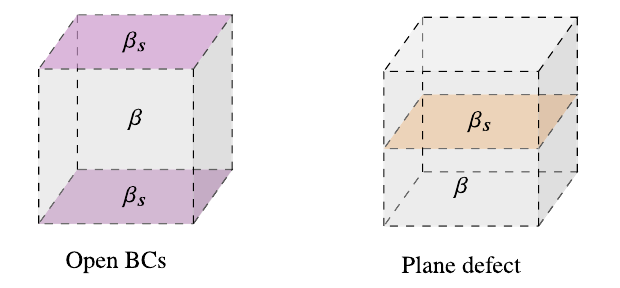
Despite decades of research, only recently it has been found out that the boundary of the most simple three-dimensional model of ferromagnet, the O(N) model, hosts a hitherto undiscovered phase, the so-called extraordinary-log phase. This is a phase where the inner bulk is critical, and a two-dimensional surface, or a defect, is almost, but not quite, ordered. See Fig. below for an illustration of the geometry.
One of the most remarkable features of this phase, that can be used as a smoking gun to detect it, is the logarithmic behavior found in many observables. For example, the response of the system to a lateral torsion, known as stiffness, grows logarithmically in the size. In this context, the project has investigated some of the relevant models, providing a quantitative characterization of the extraordinary-log phase [1].
One of the most important model in statistical physics is the Ising model, named after the physicist Ernst Ising, who studied it in his PhD thesis. In three-dimension, and in the presence of a two-dimensional boundary, the physics of the Ising model has been extensively investigated in the past, resulting in particular in a detailed understanding of its critical behavior at the surfaces. Nevertheless, its theoretical description in terms of a conformal field theory depends on a number of universal coefficients which are much less studied. This project bridged this gap by computing accurate, unbiased, values for such coefficients, for all known surface universality classes. The results are expected to provide a benchmark for future studies [2].
Acknowledgments
The principal investigator has been funded by the German Research Foundation (DFG), under the grant no. 414456783.
References
[1] F. Parisen Toldin, A. Krishnan, M. A. Metlitski, Universal finite-size scaling in the extraordinary-log boundary phase of 3d O(N) model, Phys. Rev. Research 7, 023052 (2025), arXiv:2411.05089
[2] D. Przetakiewicz, S. Wessel, F. Parisen Toldin, Boundary operator product expansion coefficients of the three-dimensional Ising universality class, Phys. Rev. Research 7, L032051 (2025), arXiv:2502.14965