


ELEMENTARY PARTICLE PHYSICS
Nuclear Lattice Simulations
Principal Investigator:
Prof. Dr. Dr.h.c. Ulf-G. Meißner
Affiliation:
Universität Bonn and Forschungszentrum Jülich GmbH, Germany
Local Project ID:
chfz02
HPC Platform used:
JUWELS Booster and Cluster at JSC, JUPITER at JSC
Date published:
Project
The matter we are made of are atomic nuclei, which are hold together by the strong force. While the fundamental theory underlying the strong interactions, Quantum Chromodynamics, is well studied at high energies, in the realm of nuclear physics we are dealing with protons and neutrons, that are build of quarks and gluons. However, at the energy scales pertinent to nuclear physics, we can not resolve this substructure. Thus, the proper first principles description of these strongly-interacting many-body systems is based on protons and neutrons, with their interactions consistently given in terms of chiral effective field theory, as initiated by Nobel laureate Steven Weinberg more than three decades ago. Combining these forces with Monte Carlo simulations on a discretized, finite spacetime (the lattice) allows for exact calculations of the A-body problem, with A the atomic number of a given nucleus. An detailed introduction is provided by the monograph1. Simulations of fermionic systems at finite density are haunted by the notorious sign problem, which in the nuclear physics case are suppressed by the approximate Wigner SU(4) spin-isospin symmetry of the forces. For neutron- or proton-rich nuclei, this symmetry is badly violated. Therefore, within this project, we developed a new method to cope with the sign-problem called wave-function matching2. This method allows for calculations with high-order chiral EFT forces, in this case at next-to-next-to-next-to-leading order (N3LO). While the parameters related to the two-nucleon forces can be determined from fitting to neutron-proton scattering data, the parameters of the three-nucleon forces must be determined from fitting the groundstate energies of assorted nuclei. Having done so, one can predict nuclear radii as well as the equation of state of nuclear and neutron matter. The predicted charge radii of nuclei with up to A = 58 nucleons compared to experiment are shown in Fig. 1. The one-standard-deviation point estimate error bars represent computational uncertainties due to MC errors, infinite volume extrapolation, and infinite time extrapolation. This solves the long-standing “radius puzzle” observed in all continuum ab initio many-body calculations, namely that when getting the correct binding energies, the nuclear radii come out too small.
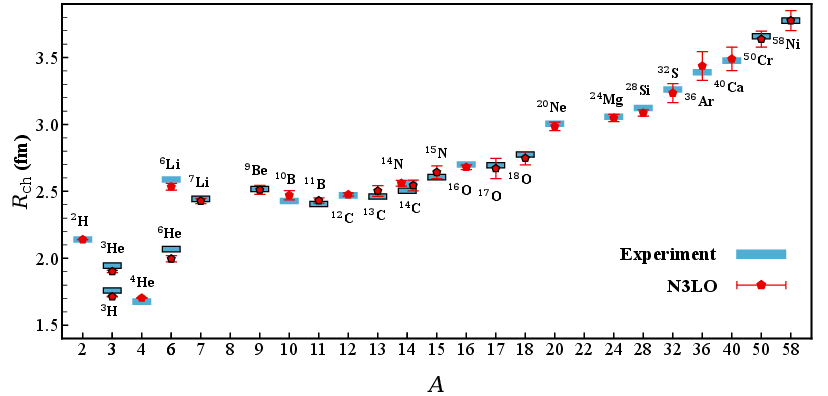
Figure 1. Predictions for charge radii of nuclei from A = 2 up to A = 58 at N3LO (red symbols) in chiral EFT in comparison to the experimental data (blue bars).
As a further test of the method, we performed a systematic ab initio study of the low-lying states in beryllium isotopes from 7Be to 12Be using the high-precision N3LO and the simpler SU(4)-symmetric interaction3. This calculation not only achieves a good agreement with experimental data for energies, radii, and electromagnetic properties, but also the prominent two-center cluster structures, the emergence of one-neutron halos, complex nuclear molecular dynamics such as pi-orbital and sigma-orbital, emerge naturally, see Fig. 2. In particular, we find that the ground state of 11Be has spin and parity SP = 1/2+, which has been a challenge to nuclear theory for a long time. These findings demonstrate the efficiency of NLEFT in capturing the intricate dynamics of of light and mid-mass nuclei. Using the Exascale possibilities that recently became available with JUPITER at Jülich (within JUREAP), we have been able to push NLEFT to the proton-rich Sn isotopes with A ≅1004, which is a major step forward and opens many new venues for ab initio nuclear theory on the lattice.
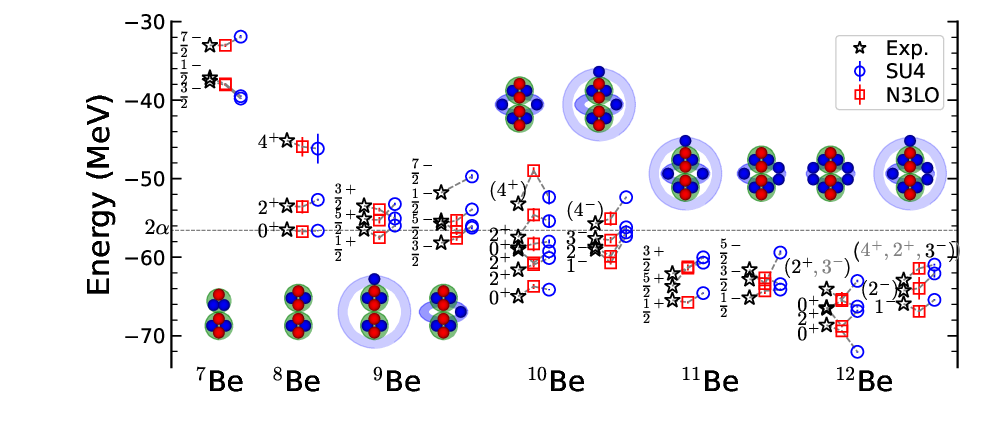
Figure 2. Low-lying spectrum from 7Be to 12Be calculated using the N3LO and SU(4) interaction, compared to the data. The error bars correspond to one standard deviation errors include stochastic errors and uncertainties in the Euclidean time extrapolation.
References
1. T. A. Lähde and U.-G. Meißner, “Nuclear Lattice Effective Field Theory: An introduction,” Lect. Notes Phys. 957 (2019), 1-396 Springer, 2019, ISBN 978-3-030-14187-5, 978-3-030-14189-9 doi:10.1007/978-3-030-14189-9
2. S. Elhatisari, L. Bovermann, Y. Z. Ma, E. Epelbaum, D. Frame, F. Hildenbrand, M. Kim, Y. Kim, H. Krebs and T. A. Lähde, et al. “Wavefunction matching for solving quantum many-body problems,” Nature 630 (2024) no.8015, 59-63 doi:10.1038/s41586-024-07422-z
3. S. Shen, S. Elhatisari, D. Lee, U.-G. Meißner and Z. Ren, “Ab Initio Study of the Beryllium Isotopes Be7 to Be12,” Phys. Rev. Lett. 134 (2025) no.16, 162503 doi:10.1103/PhysRevLett.134.162503
4. F. Hildenbrand, S. Elhatisari, U.-G. Meißner, H. Meyer, Z. Ren, A. Herten and M. Bode, “Lattice Calculation of the Sn Isotopes near the Proton Dripline,” Phys. Rev. Lett. 136 (2026) no.6, 062501 doi:10.1103/n7nt-s64t