


ELEMENTARY PARTICLE PHYSICS
Simulation of Spin-Polarized Particle Generation in Laser-Plasma Interaction
Principal Investigator:
Prof. Dr. Zheng Gong
Affiliation:
Chinese Academy of Sciences, Institute of Theoretical Physics, Beijing, China
Local Project ID:
splpi
HPC Platform used:
JUWELS CPU at JSC
Date published:
Teaser
Researchers at the Institute of Theoretical Physics, Chinese Academy of Sciences, used the JUWELS supercomputer at Jülich Supercomputing Centre to explore how intense laser pulses interacting with plasma can produce spin-polarized particle beams. By performing large-scale particle-in-cell simulations that track both particle motion and spin dynamics, the project uncovered how magnetic fields, radiation effects, and plasma inhomogeneities shape spin polarization—insights that may guide future experiments and applications in high-energy physics and astrophysics.
Project Report
What was the challenge?
Generating spin-polarized particle beams, where the microscopic spins of electrons or ions are aligned, has long been a goal in accelerator and plasma physics. Such beams are vital for probing fundamental interactions and for developing advanced radiation and particle sources. However, achieving spin polarization in laser-driven plasma accelerators is particularly challenging. The extreme electromagnetic fields and ultrafast timescales make it difficult to predict or control how particle spins evolve during acceleration. Understanding these processes requires detailed modeling that captures both the collective plasma behavior and the quantum spin dynamics of individual particles.
Why was supercomputing power required?
The problem involves solving billions of coupled equations that describe how charged particles move and spin in electromagnetic fields that change on femtosecond timescales. These simulations employ the particle-in-cell (PIC) method extended with spin-tracking based on the Bargmann-Michel-Telegdi (BMT) equation. Accurately modeling spin-dependent radiation effects and field inhomogeneities demands extremely fine spatial and temporal resolution, achievable only on large-scale high-performance computing (HPC) systems. The JUWELS CPU cluster at JSC provided the necessary computing capacity and parallel scalability to perform these fully relativistic multi-dimensional simulations within a reasonable time.
What are the findings?
The simulations revealed several key mechanisms responsible for generating spin polarization in laser-plasma interactions.
- Radiation reaction effects: As electrons emit radiation in strong fields, asymmetric spin flipping can occur, leading to partial alignment of spins.
- Magnetic precession: Both external and self-generated magnetic fields cause the spins to precess, influencing the overall polarization direction.
- Plasma inhomogeneities: Variations in plasma density modify particle trajectories, introducing local asymmetries that further enhance spin polarization.
By systematically varying the laser intensity, plasma density, and external magnetic field, the project identified optimal conditions under which the degree of spin polarization is maximized. The results suggest that it is feasible to generate highly polarized particle beams from laser-driven plasma, which could later be validated in laboratory experiments.
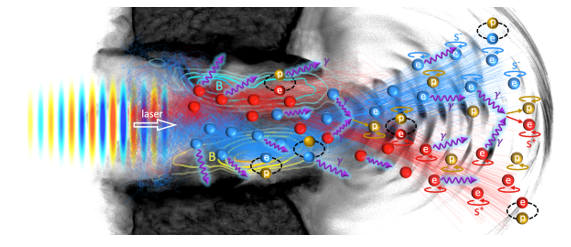
Figure 1. Schematic of spin-polarized particle generation in laser-plasma interaction.
Who will benefit and how?
These findings contribute directly to the international effort of developing compact, laser-based particle accelerators as potential next-generation sources for high-energy physics experiments. Spin-polarized beams are also valuable in nuclear and materials science and in modeling astrophysical phenomena such as cosmic-ray acceleration and magnetized shocks. The knowledge gained from the JUWELS simulations provides theoretical guidance for upcoming experiments at large laser facilities and offers practical strategies to control polarization through tailored plasma and field configurations.
Scientific Dissemination
Results from this project have been published in leading international journals, including:
[1] Shen, X., Gong, Z., Hatsagortsyan, K. Z., & Keitel, C. H. Phys. Rev. Research 6, L032075 (2024). doi.org/10.1103/PhysRevResearch.6.L032075
[2] Gong, Z. et al. Phys. Rev. Lett. 131, 225101 (2023). doi.org/10.1103/PhysRevLett.131.225101
[3] Gong, Z. et al. Matter and Radiation at Extremes 8, 064005 (2023). https://doi.org/10.1063/5.0152382