


MATERIALS SCIENCE AND CHEMISTRY
Ab Initio Investigation of Interfacial Processes Under Harsh Conditions
Principal Investigator:
Prof. Dr. Michael Moseler
Affiliation:
Fraunhofer-Gesellschaft, Fraunhofer Institute for Mechanics of Materials (IWM)
Local Project ID:
harsh
HPC Platform used:
JUWELS CPU at JSC
Date published:
Abstract
In this project, researchers from Fraunhofer IWM and the University of Freiburg explored how materials respond when exposed to harsh mechanical or chemical conditions altering the chemical structure close to the surface. This can lead to high friction and wear but also to unexpected effects or even to beneficial materials modifications. Applications range from machine tools, triboelectricity to functional materials for solar water‑splitting devices. Large‑scale quantum‑mechanical simulations revealed, among other findings, how to predict and understand friction under high pressure - where chemical bonds continuously break and reform - how to hydrogenate titanium dioxide (TiO2) efficiently at room temperature to enhance its functional properties, and how the interplay between chemistry and mechanically induced bond breaking drives the everyday phenomenon of static charging in tribological contacts.
Project Report
Many technological applications and scientific phenomena are decided at interfaces where different materials come into contact. Under harsh conditions (high pressure, temperature, repeated load or presence of reactive species), these interfaces evolve: chemical bonds break and reform, radicals emerge and react with chemical species from the environment or with atoms from the counter body. Modelling this time‑dependent, atomic‑scale processes at interfaces is essential to explain wear and friction but can also be applied to the efficiency of material modification via hydrogenation or to the everyday phenomenon of contact electrification. With experimental investigations alone it is often very difficult to directly observe the relevant elementary processes on the atomistic level.
Simulating physicochemical processes at interfaces requires ab initio (first‑principles) methods which enable the treatment of materials properties on a quantum‑mechanical level. Such simulations are computationally very demanding, especially for realistic interfaces and complex phenomena. Therefore, sufficient computational resources were required for this project and were provided by the JUWELS supercomputer. In the following published examples of the studies conducted within the project are summarized.
Dry friction in machining
Metal cutting is of high importance in many manufacturing processes. Cutting simulations can help to enhance the efficiency and to reduce detrimental effects on the processed parts. An important ingredient of such simulations is the friction at the interface between cutting tool and machined part under high pressures and temperatures, as it determines wear, energy consumption and overall processing quality. Yet the local interfacial friction is hard to measure in experiments and existing friction laws suffer from limited ranges of applicability. Here, ab initio atomistic shear simulations (DFT molecular dynamics) of realistic, mixed-chemistry tribolayers were used to determine friction law versus normal pressure. The chemical composition of the contacts was determined by advanced experimental surface characterization techniques. The microscopic friction law was combined with contact mechanics simulations and finite‑element models. This multiscale approach predicted cutting forces with only ~5% average error across 15 conditions without the need of fitting parameters to experimentally determined forces.
Dry friction in SiC/graphene/diamond contacts
Graphene, an ultrathin material made from carbon atoms has raised immense research activities over the last 20 years due to its extraordinary properties. Among many other things, it enables ultra‑low friction, yet at high pressure its performance can deteriorate as was shown in atomic force microscopy experiments where nanoscale tips made of diamond and silicon were pressed and slid against graphene layers adsorbed on top of silicon carbide (SiC). The surfaces of these tips consist of amorphous carbon (a‑C) in the case of the diamond and silicon oxide (SiO2) in the case of silicon. Using quantum‑chemical simulations (DFTB molecular dynamics), a-C and SiO2 surfaces sliding against graphene on SiC were modelled and three pressure‑driven regimes were found in agreement with experiments: low-friction sliding without chemical interaction at low pressures, the onset of covalent bond formation induced by the mechanical load, and full bonding of the interfaces with extremely high friction at very high pressures. Interesting differences are observed between the diamond and silicon tips: The stiffer a‑C shifts shear toward the graphene/SiC interface while the softer SiO2 localizes shears inside the oxide. The work explains the stability/instability of low‑friction graphene interfaces with possible implications for example in the field of micro-electro-mechanical systems (MEMS).
https://doi.org/10.1103/PhysRevResearch.5.L012049
https://doi.org/10.1002/admi.202500511
Efficient hydrogenation of TiO2
The modification of functional material properties by hydrogenation is an active research field with potential applications in solar hydrogen production, energy conversion and electronics. The prototypical material studied in this context is titanium oxide (TiO2). In particular, hydrogen treatment can boost the ability of TiO2 to split water into oxygen and hydrogen with the help of sunlight in a photoelectrochemical process. Common hydrogenation methods use high temperatues and gas pressures that can affect the material properties negatively. Building on large‑scale ab initio simulations (DFT molecular dynamics), it was shown that energetic species originating from a hydrogen plasma enter TiO2 much more easily than H2 dimer molecules from a conventional hydrogen gas atmosphere. This explains why a modified plasma treatment process developed by experimental partners works considerably more efficient requiring treatment times of only 5 minutes and operating at room temperature. Without the detrimental effects from high-temperature treatments, an unprecedented photoelectrochemical performance of the hydrogenated TiO2 could be achieved.
https://doi.org/10.1002/smll.202204136
Oxidized mechanoradicals drive contact electrification
Polytetrafluoroethylene (PTFE), better known as Teflon, usually charges negatively when rubbed against other materials. The origin of this behaviour and in general of the electrification of contacts responsible e.g. for the charging of children’s hairs when they rub a ballon is not well understood. Using advanced quantum calculations (DFT and many‑body GW), we studied the charging of PTFE in contact with gold. It was found that pristine PTFE cannot stably accept electrons from the metal surface. However, during contact, high mechanical stresses on the atomistic scale lead to the breaking of chemical bonds and the formation of so-called mechanoradicals. Those highly reactive species quickly react with oxygen and water molecues from the surrounding leading to the formation of oxygen‑containing radicals. These defects have energetics that favor the transfer of integer electrons from the metal, explaining PTFE’s strong affinity to acquire negative charges. A simple model based on electrostatics and quantum-mechanical tunneling shows how the charge stays trapped as the surfaces separate: At distances of several tens of nanometers where the back-transfer of charges becomes energetically viable, it is vanishingly unlikely due to a strong suppression of tunneling probability. The work clarifies the mechanochemistry behind everyday electrostatics and might be of relevance to optimize and design triboelectric energy harvesters in the future.
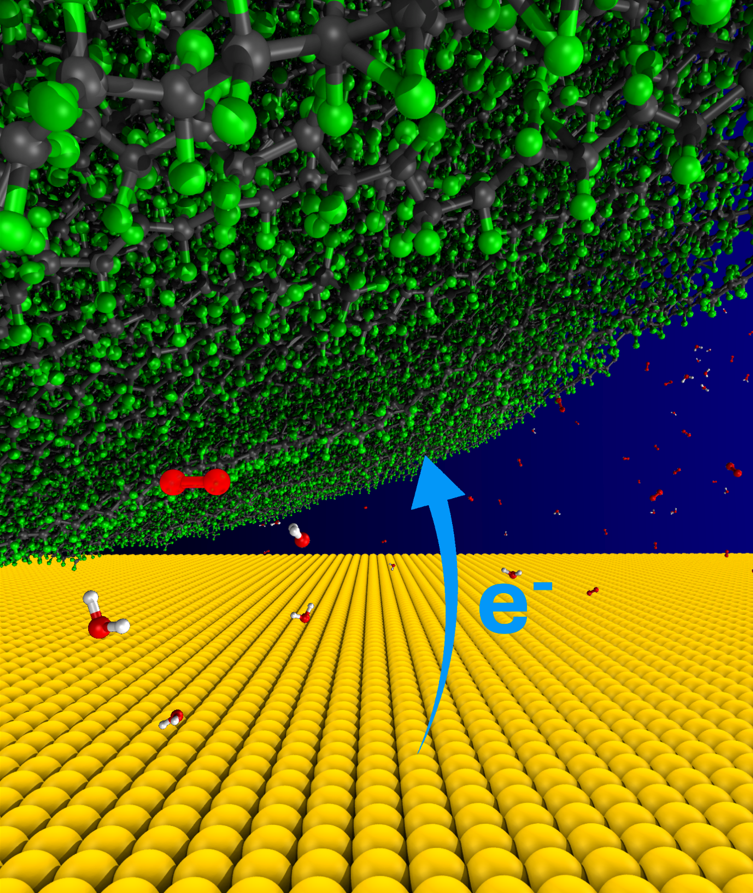
Oxidation of mechanoradicals in PTFE by ambient H2O and O2 molecules creates electron-affine defect states that drive electron transfer leading to contact electrification of an Au/PTFE interface.