


MATERIALS SCIENCE AND CHEMISTRY
Bubble Transport in Constrained Channels and Porous Media
Principal Investigator:
Dr. Qingguang Xie
Affiliation:
Forschungszentrum Jülich GmbH, IET-2 Helmholtz Institute Erlangen-Nürnberg for Renewable Energy, Germany
Local Project ID:
Bubble
HPC Platform used:
JUWELS Cluster at JSC
Date published:
The formation and transport of gas bubbles are crucial in various electrolyzers, flow batteries, and catalytic reactors. Many of these applications employ porous materials, which serve as either catalyst supports or electrodes. Understanding the dynamics of bubble evolution and transport within these porous microstructures is key to optimizing the morphology of the porous materials and enhancing the overall efficiency of these devices. However, this understanding remains limited, largely due to the opacity and complexity of the microstructures, which make it difficult to observe and quantify bubble behavior in real-time.
Computer simulations provide a powerful alternative, enabling detailed modeling and analysis of bubble formation and transport within such complex systems. A team of physicists from the Helmholtz Institute Erlangen-Nürnberg recently performed state-of-the-art simulations to deepen the understanding of bubble dynamics in porous media. The simulation was performed using their in-house lattice Boltzmann code, 3nskog, a highly efficient, MPI‑parallelized implementation for multicomponent flows. They obtained reconstructed X-ray tomography data of a realistic porous transport layer, provided by their experimental collaborators for use in water electrolysers, and integrated this data into their simulations.
By leveraging this advanced approach and the computational power of the JUWELS Cluster, the research uncovers the complex dynamics of bubbles and identifies the key factors that govern bubble transport in porous media. The team is able to track the evolution of bubbles as they move through the medium, capturing processes such as elongation, detachment, breakup, and coalescence. This provides detailed insights into the factors influencing bubble breakthrough time, including the effects of pore surface wettability, reaction rate, and pressure.
Future work will extend these studies to integrate the transport of bubbles in porous media with ion/electro transport, electrochemical reaction in catalyst layer (nanoscale), as well as bubble/gas transport in bipolar plate channels (macroscale). The goal is to develop a multiscale model capable of simulating the entire device to predict overall system performance. Ultimately, this research will provide guidance on how to design optimized pore geometries and how to tailor material surface properties to improve performance in applications such as water electrolyzers, fuel cell and flow batteries.
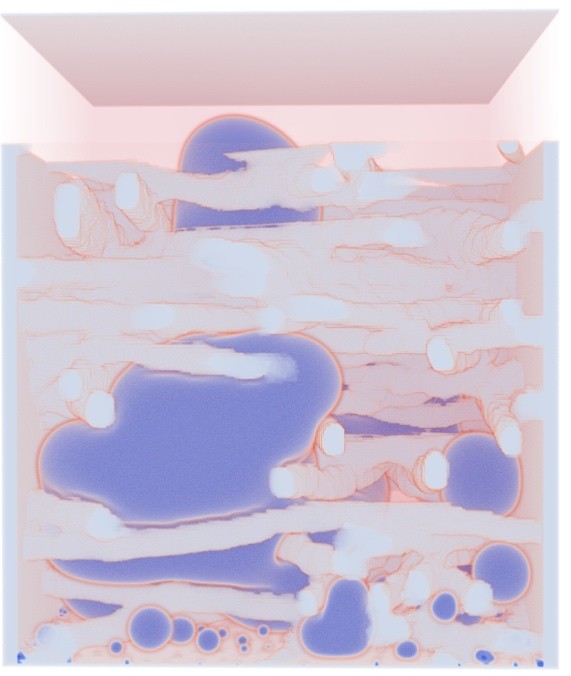
The image shows the transport and deformation of bubbles (blue) inside a porous transport layer (light gray). The water is represented by light red.