


RESEARCH HIGHLIGHTS
Our research highlights serve as a collection of feature articles detailing recent scientific achievements on GCS HPC resources.
UNSEEN Project Uses High-Performance Computing to Transform Energy System Modelling
Research Highlight –
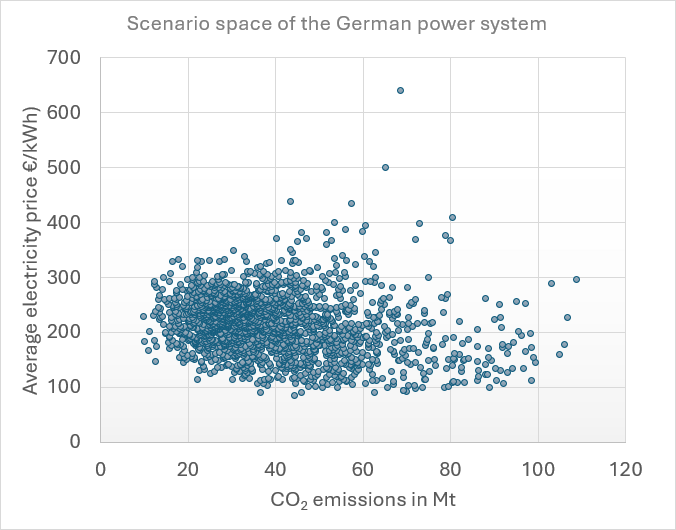
Researchers recently used JUWELS to analyze 11,000 different scenarios for the German energy system. The team wants to give decision makers insights into how different decsions regarding energy policy can impact greenhouse gas emissions, energy availability, and other metrics. Image credit: Karl-Kiên Cao, DLR.
Global conflicts, climate change, and other sources of volatility in energy markets make it hard for decision makers to plan for a secure, sustainable power supply for the future. Mathematicians and energy researchers work with civic leaders to develop energy scenario analyses that provide a range of possibilities for future energy demands and potential challenges for meeting them. However, until recently, researchers could only efficiently create energy scenario analyses with a small number of scenarios that relied heavily on certain assumptions and did not strongly consider the influence of uncertainty on these systems.
Over the last several years, as part of the UNSEEN project, researchers have used the JURECA-DC and JUWELS Cluster supercomputers at the Jülich Supercomputing Centre (JSC) to take energy scenario analysis to new heights. In its recent paper in Nature Communications, the team presented a modelling workflow that included more than 11,000 scenarios for Germany’s power system with a wide range of inputs. Taken together, these analyses deepen future prediction power related to energy costs, security of energy supply, and sustainability. Researchers from the German Aerospace Agency (DLR), JSC, the Zuse Institute Berlin (ZIB), TU Berlin, and GAMS Software GmbH all contributed to the work.
“HPC is not an established approach for our research domain,” said Dr. Karl-Kiên Cao, postdoctoral researcher at DLR and scientific coordinator on the project. “At the same time, researchers doing energy scenario analysis are increasingly confronting impractical computing time using laptops or smaller shared clusters. For us, developing our application to scale on HPC was a logical next step, and required us to develop appropriate software solvers to do this work efficiently.”
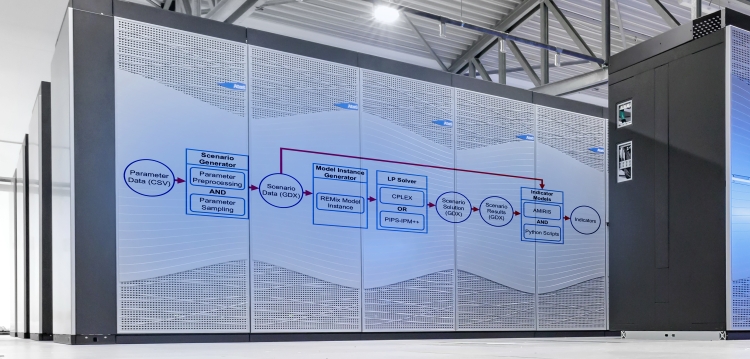
Until recently, energy optimization researchers had not ported many of their workflows to supercomputers. Access to JUWELS at JSC helped the team scale its application to new heights. Image credit: JSC.
Multidisciplinary collaboration promotes better energy system analysis
In 2015, JSC joined a multi-institution project focused on using Germany’s computing power to better support energy systems modelling. The project, BEAM-ME, was led by DLR and included computational experts from two Gauss Centre for Supercomputing centers—JSC and the High-Performance Computing Center Stuttgart. The project’s success led to the follow-up project, UNSEEN, which started four years later.
While researchers in BEAM-ME were primarily focused on improving algorithmic efficiency and codes for energy optimization problems, the work in UNSEEN has been focused on taking those improvements and running improved energy system analyses while looking for opportunities to further optimize computational workflows.
To create the most realistic energy system analysis possible, researchers must pull together a wide variety of open-source data: existing power plants’ production capacities, hour-by-hour energy demand patterns in Germany, current and projected future power production from renewable energy sources, and climate change models, while also making projections for how population shifts, changes to how energy is produced and priced, and myriad other uncertainties will influence future power generation. “The largest original datasets included in this kind of modelling—historical meteorological data—are typically heavily simplified, but according to our findings, this data has a large impact on the design of future energy systems, so we needed to develop a better understanding of what is an acceptable degree of simplification for these analyses,” Cao said.
The DLR researchers worked closely with JSC’s Thomas Breuer to improve their computational workflows. Ultimately, the team wanted to focus not only on adding more realism to simplifications in its models, but also improve how uncertainties are weighted. “To support the team, we first had to understand how the code and processes worked in their existing environment so that we could transfer them to an HPC environment in the best way possible, including the many interactions of individual components of the workflow,” Breuer said.
Breuer helped the team establish its workflow using JSC’s JUBE workflow management tool and colleagues from ZIB, TU Berlin and GAMS worked with the team to adapt the PIPS-IPM++ solver for energy system modelling, which it intends to further optimize for more efficient analyses. In its recent calculations that were published in the Nature Communications paper, the team found that four of the energy system scenarios for Germany were nearly optimal for several of the team’s seven indicators connected to affordability, supply-security, and sustainability goals.
Powering up for future optimization research, more informed predictions
With these encouraging results in hand, the team is looking to further optimize its workflow so it can run these analyses more quickly. The researchers also want to continue improving how to include more accurate assumptions and how to better account for various types of uncertainty in its models. In addition to making their solver more user-friendly for energy system modelers, the team is currently preparing benchmarking experiments to compare how their workflow would run on shared memory systems, distributed memory systems, and GPU-based solutions.
For Cao, the emphasis moving forward is two-pronged—running large-scale, computationally intensive models that can further improve models that other researchers can use on less powerful computers and presenting research findings to decision makers in an actionable manner. “Our domain is not used to evaluating large ensemble studies like these,” Cao said. “Therefore, it is a challenge to extract core findings from these huge datasets and present them in ways that will help decision makers in guiding future energy policy decisions.” However, now that the team has the ability to develop HPC-based analyses, it is now focused on creating new opportunities for collaboration across disciplines and turning complex modelling results into practical insights for relevant authorities.
-Eric Gedenk
Related Publication: Frey, U. et al (2025). “The Benefits of Exploring a Large Scenario Space for Future Energy Systems,” Nature Communications. DOI: https://doi.org/10.1038/s41467-025-67593-9
Funding for JUWELS was provided by the Ministry of Culture and Research of the State of North Rhine-Westphalia and the German Federal Ministry of Research, Technology and Space through the Gauss Centre for Supercomputing (GCS).