


ELEMENTARY PARTICLE PHYSICS
When Water Gets Squeezed: How Nano-Droplets Rewrite the Rules of Proton Chemistry
Principal Investigator:
Dr. Ana Vila Verde
Affiliation:
Universität Duisburg-Essen, Germany
Local Project ID:
PRODYN-RM/Acid 44309
HPC Platform used:
Hawk at HLRS
Date published:
Summary
What if the familiar rules of water chemistry break down inside the tiny pockets of a living cell? A team at the University of Duisburg-Essen used the Hawk supercomputer at HLRS Stuttgart to track single protons inside reverse micelles — water droplets just a few nanometres across that mimic the confined environments found in enzymes, fuel-cell membranes and catalysts. The simulations reveal that confinement changes the rules: a proton can stick to the surfactant walls of the droplet, something that does not happen in ordinary bulk water, opening competing pathways that may explain why nature so often does its chemistry in tight spaces.
The story
Protons — the bare nuclei of hydrogen atoms — are the smallest mobile charges in chemistry. Their movement powers acid-base reactions, drives respiration inside our cells, and underlies modern fuel-cell technology. Importantly, the chemistry that matters in life and in many technologies happens not in bulk, but in tight spaces: inside the pockets of an enzyme, between membrane layers, or in the nano-channels of a polymer fuel-cell membrane. How protons move and distribute in those confined worlds has remained an open question.
A team led by Dr. Ana Vila Verde at the University of Duisburg-Essen, together with Dr. Sulejman Skoko, set out to find out using simulations. Their project, “Exploring Proton Dynamics in Confinement: A Study of Photoacids in Reverse Micelles” (Project ID Acid 44309), used the Hawk supercomputer at the High-Performance Computing Centre Stuttgart (HLRS) to watch single protons move inside reverse micelles — water droplets just a few nanometres across, stabilised by a layer of the surfactant AOT — in the presence of the photoacid HPTS. The photoacid molecul was used in the accompanying ultrafast spectroscopy experiments performed by the experimental teams of Prof. Dr. Poul Petersen’s group at Ruhr University Bochum and Prof. Dr. Nancy Levinger at Colorado State University, Colorado, USA.
Why a supercomputer was needed
A proton hops between water molecules in less than a trillionth of a second — far too fast for any laboratory camera. To follow the action, the team combined two simulation worlds: quantum mechanics for the proton and its immediate neighbours, where chemical bonds break and re-form, and classical mechanics for the much larger surrounding micelle and solvent. Twenty independent QM/MM simulations were run, each modelling 20 picoseconds of motion at 0.5-femtosecond resolution. To complete them in months rather than decades, the team used 128 to 256 cores per simulation on Hawk. A previously undocumented hardware bottleneck on the machine made the runs more expensive than originally planned, but the full 21 million core hours granted were consumed and every simulation was completed.
What the team found
The results were striking. Inside the reverse micelle, protons did not behave as they do in bulk water. In several simulations the proton was captured by the negatively charged sulfonate groups on the surfactant walls of the droplet — chemistry that never occurred in the matched bulk-water control simulations. Some runs even saw the proton attach to sulfonate groups on the HPTS molecule itself. Confinement, in other words, does not just slow proton motion: it changes which destinations the proton finds attractive in the first place. The team identified multiple competing pathways for a proton to follow after release, with the dominant route shaped by the local water structure and electrostatics inside the droplet rather than by intrinsic chemical reactivity.
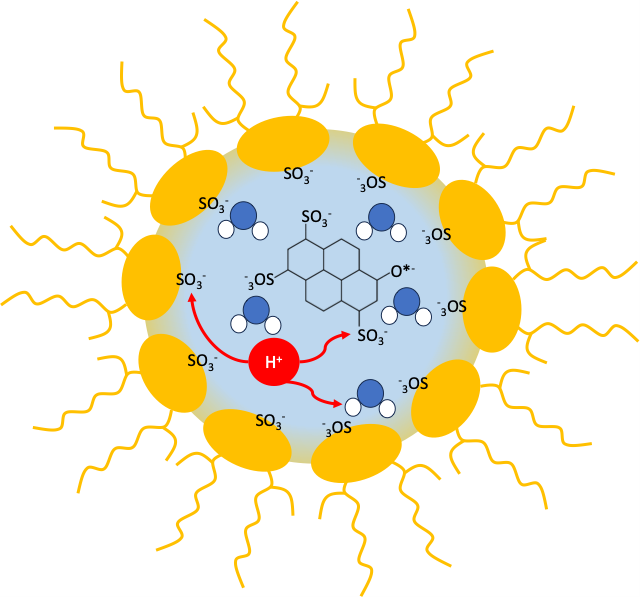
Figure 1. Where the excess proton ends up. In ordinary bulk water it hopps between water molecules. Inside a reverse micelle stabilised by the surfactant AOT (yellow) it can transiently attach to the negatively charged sulfonate (SO₃⁻) head groups that line the wall — a confinement-driven pathway not seen in the matched bulk-water control simulations—to the sulfonate groups in HPTS or to water. Illustration: original schematic, not a reproduction of project data.
Who benefits
These insights matter wherever protons travel in tight quarters. Enzymes accelerate biological reactions by confining substrates and protons inside narrow active sites; fuel-cell membranes such as Nafion route protons through nanometre-wide water channels; and many emerging catalysts and energy-storage materials rely on similarly confined water. A more accurate molecular picture of confined proton transfer will help researchers in catalysis, in cleaner energy technologies and in biophysics design better systems, and will help the team’s experimental collaborators interpret time-resolved spectroscopy of photoacids with new physical clarity.
Further reading and references
A peer-reviewed manuscript describing the present results is in preparation by S. Skoko and A. Vila Verde (University of Duisburg-Essen), in collaboration with the groups of Prof. Dr. Poul Petersen at Ruhr University Bochum and Prof. Dr. Nancy Levinger at Colorado State University.
Acknowledgement : The authors gratefully acknowledge the Gauss Centre for Supercomputing e.V. (www.gauss-centre.eu) for funding this project by providing computing time on the GCS Supercomputer HAWK at Höchstleistungsrechenzentrum Stuttgart (www.hlrs.de) under grant number Acid 44309. AVV and SK acknowledge the Deutsche Forschungsgemeinschaft (DFG, German Research Foundation) under Germany’s Excellence Strategy - EXC 2033 – 390677874 – RESOLV.
Image: original conceptual schematic prepared for the popular-science version of this report. It is not a reproduction of project simulation data. Project data and scientific figures will be released through the team’s peer-reviewed publication.