


LIFE SCIENCES
Why Fluorine Repels Water — and why it Matters for Tomorrow’s Medicines
Principal Investigator:
Dr. Ana Vila Verde
Affiliation:
Universität Duisburg-Essen, Germany
Local Project ID:
HySoF
HPC Platform used:
Hawk at HLRS
Date published:
Summary
Roughly one in three new medicines contains fluorine — yet science still cannot fully explain why swapping hydrogen for fluorine in a molecule makes it shun water so strongly. A team at the University of Duisburg-Essen, led by Dr. Ana Vila Verde, used the Hawk supercomputer at HLRS Stuttgart to simulate, atom by atom, how water rearranges itself around fluorinated and non-fluorinated cousins of common solvents. The first results overturn a long-standing assumption: simple gases such as methane are not, in fact, reliable miniature models for understanding fluorine’s water-repelling effect in tomorrow’s drugs and materials.
The story
About one in three new pharmaceutical drugs entering the market today contains at least one fluorine atom. Fluorine bonds tightly to carbon and resists chemical breakdown. Crucially, perfluorination — the replacement of all hydrogens in CH2 or CH3 groups — makes the molecules far less attracted to water. That “water-shy” behaviour, known as hydrophobicity, helps drug molecules slip through biological membranes to reach their targets. The same effect underlies the non-stick coating on cookware (Teflon, a fully fluorinated polymer) and many modern crop-protection chemicals.
Yet despite decades of study, scientists still cannot fully explain, at the level of individual atoms, why perfluorinated groups are so hydrophobic. Established theories assume that fluorination simply forces water to make a larger, more disruptive “cage” around the molecule. Recent experiments by the team’s collaborators showed that this picture is too simple: in some cases the non-fluorinated cousin actually disturbs the surrounding water more than the fluorinated one.
To settle the question, a project led by Dr. Ana Vila Verde at the University of Duisburg-Essen set out to watch water do its thing one atom at a time. Together with PhD candidate Mr. Elio Casalini and Dr. Sulejman Skoko — both also at the University of Duisburg-Essen — the team ran Ab Initio Molecular Dynamics simulations on the Hawk supercomputer at the High-Performance Computing Centre Stuttgart (HLRS), under the project “Hydrophobic solvation features of small molecules upon perfluorination” (Project ID HySoF/44310, internal reference Acid 44310).
Why a supercomputer was needed
Conventional molecular simulations treat atoms as classical billiard balls, glossing over quantum-mechanical effects. To capture those subtleties, the team had to solve the equations of quantum physics for every atom in a virtual box of more than 250 water molecules, repeated millions of times to build up a film of how the system evolves. Earlier tests on the team’s local cluster needed two months to produce a single short trajectory — and the result was too noisy to draw firm conclusions. Hawk, with its thousands of processor cores, made it possible to run fifty independent simulations in parallel: enough to average out the noise and obtain trustworthy “vibrational spectra” that act as atomic-scale fingerprints of how water moves around each molecule.
What the team found
Water arranges itself very differently around ethanol (the alcohol in drinks) and its fluorinated counterpart 2,2,2-trifluoroethanol (TFE). They found that roughly 3.5 times as many water molecules turn their hydrogens towards TFE than towards ethanol— a subtle structural signature the simulations now reproduce with a fully quantum-level description. Even more strikingly, the opposite trend appears for methane and its perfluorinated cousin tetrafluoromethane: water turns away only about half as often around the fluorinated version. This challenges the long-held assumption that simple alkanes and perfluoroalkanes are good miniature models for the fluorinated groups found in real drugs and polymers. This different arrangement of water molecules near TFE and ethanol is responsible for the markedily different dynamics of their solvation shell, visible in the different vibrations of the water network in the teraherz region found in the simulations, and in the teraherz spectroscopy experiments conducted by the team led by Prof. Dr. Martina Havenith at the Ruhr-University Bochum.
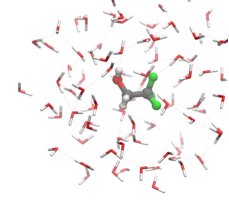
Figure 1. Schematic of one of the systems investigated: TFE in water.
Who benefits
A clearer molecular picture of fluorine’s influence on the structure and dynamics of water will help pharmaceutical chemists design more effective drug candidates, polymer scientists tailor new fluorinated materials, and agrochemical developers fine-tune pesticide behaviour. More fundamentally, the work advances the textbook understanding of hydrophobicity itself. The simulations also produce a benchmark dataset against which faster but less accurate methods can now be validated, paving the way for cheaper screening of fluorinated candidate molecules in the years to come.
Further reading and references
A peer-reviewed manuscript describing the present results has been published: Perfluorinated alkyl groups induce unexpected hydrophobic hydration structure S. Schulke, E. Casalini, J. Kaur, S. Skoko, G. Schwaab, M. Havenith, and A. Vila Verde Physical Chemistry Chemical Physics, 28(14):8626–8640, 2026 DOI: 10.1039/D5CP04598C
Acknowledgement (as supplied by the team): “The authors gratefully acknowledge the Gauss Centre for Supercomputing e.V. (www.gauss-centre.eu) for funding this project by providing computing time on the GCS Supercomputer HAWK at Höchstleistungsrechenzentrum Stuttgart (www.hlrs.de) under grant number HySoF/44310, and the Deutsche Forschungsgemeinschaft (DFG, German Research Foundation) under Germany's Excellence Strategy – EXC 2033 – 390677874 – RESOLV.
Image: original conceptual schematic prepared for the popular-science version of this report. It is not a reproduction of project simulation data. Project data and scientific figures will be released only after peer-reviewed publication.